
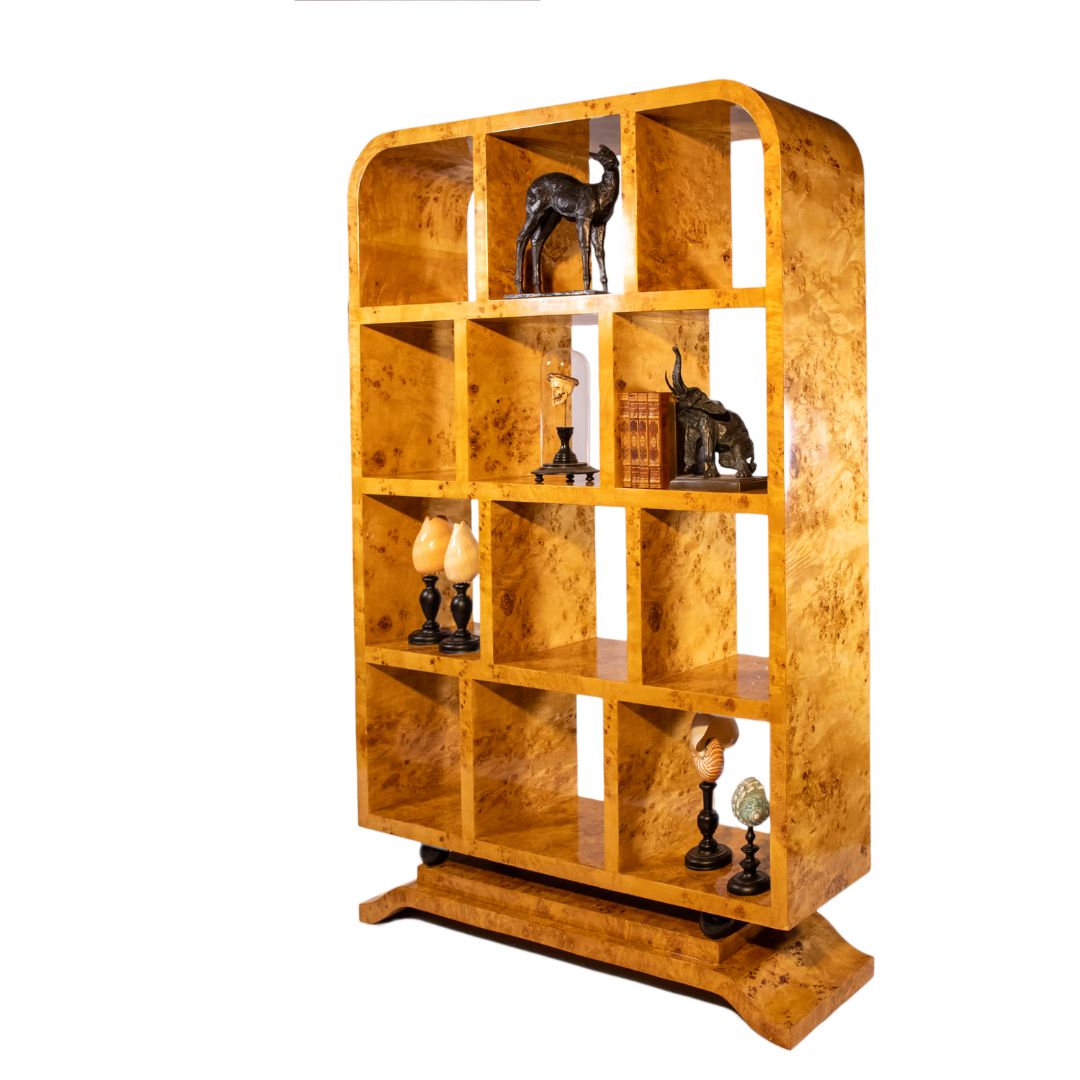

Art Deco Side Tables
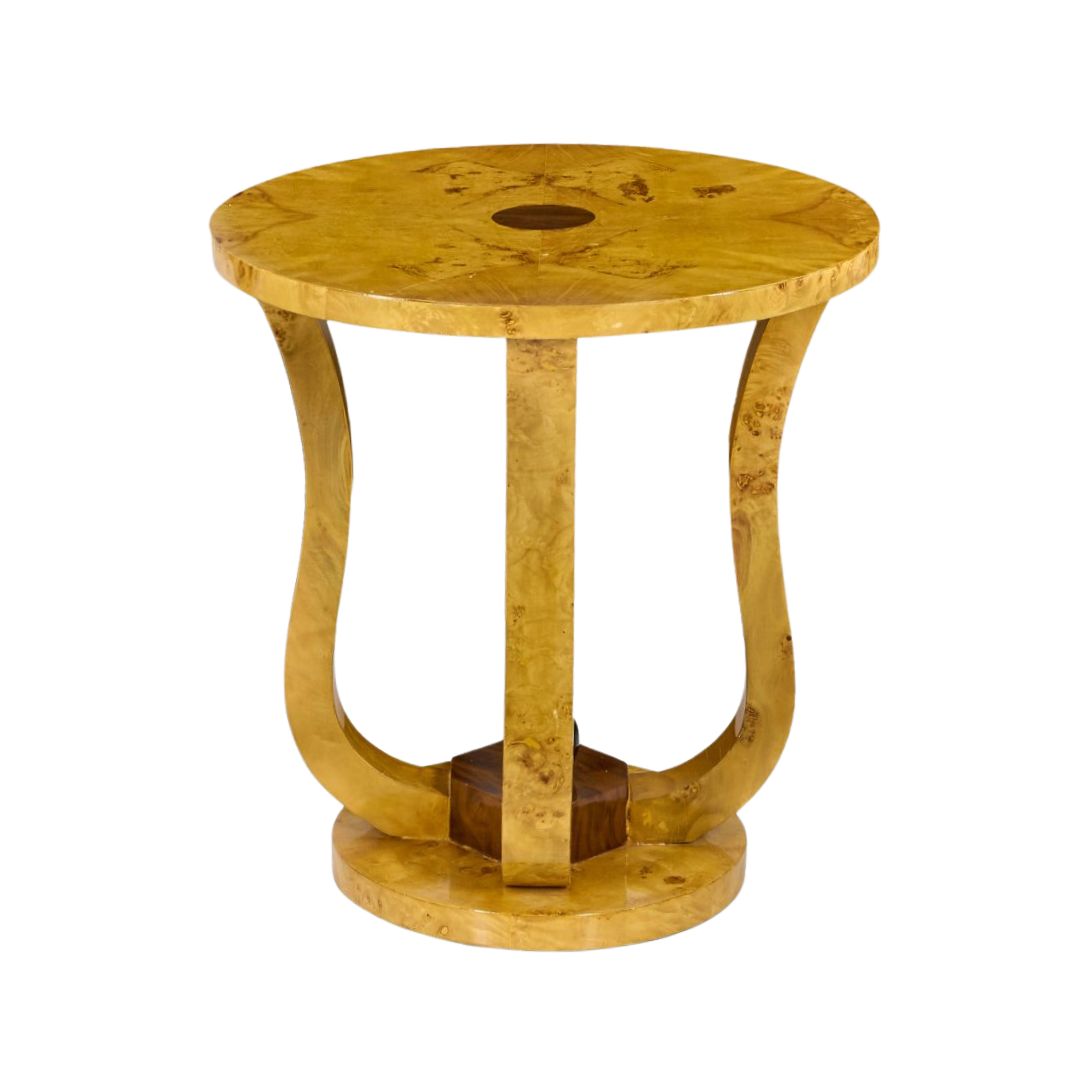
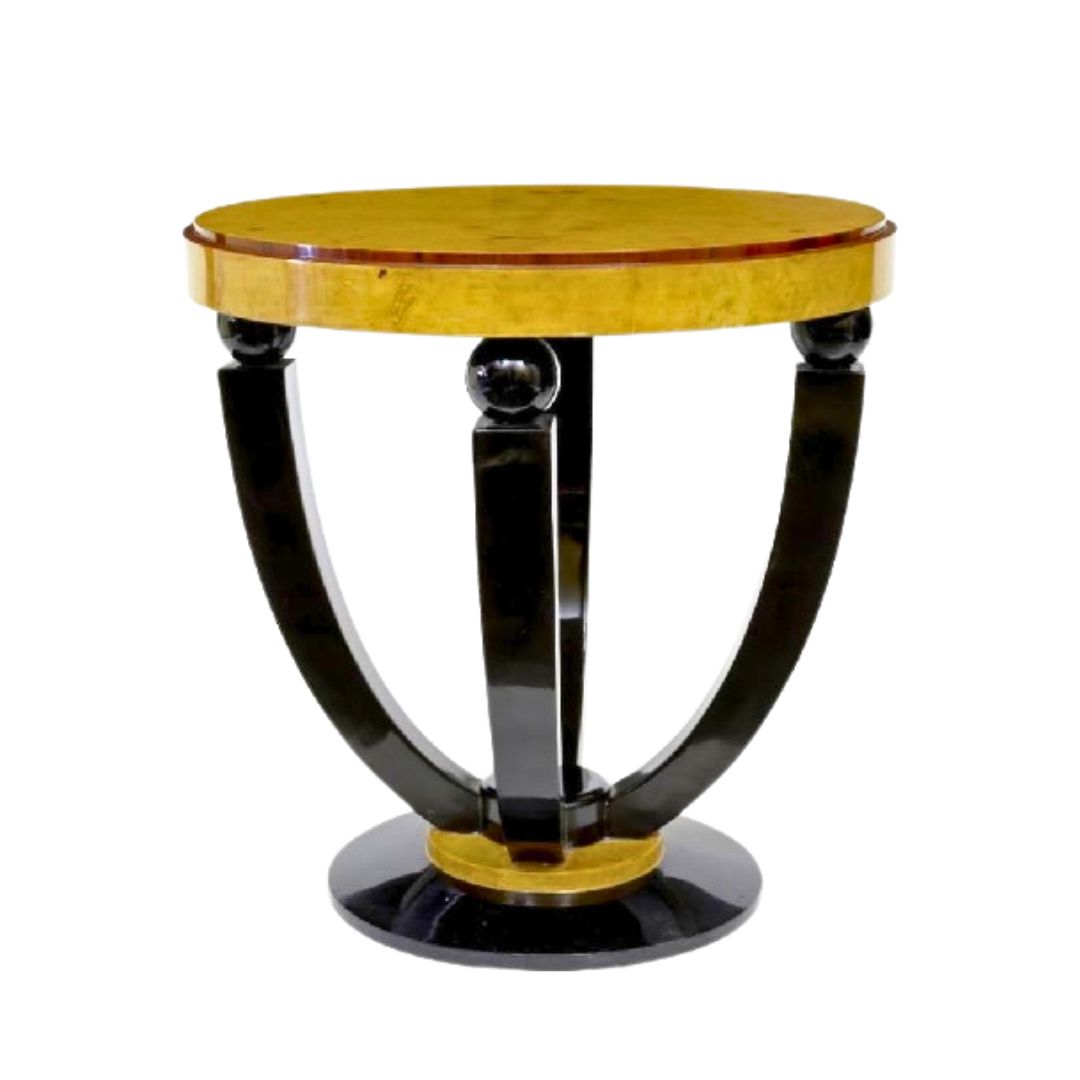
Art Deco side tables made by hand, most with a round top in book-matched burr walnut veneer, gloss-varnished. Bases range from curved black-lacquered legs to stepped plinths and ebony spheres; the Nocturne has a Macassar ebony top and the Montclair a square one. The Speakeasy and the Coltrane are broad enough to serve as coffee tables.
Buying handmade Art Deco side tables
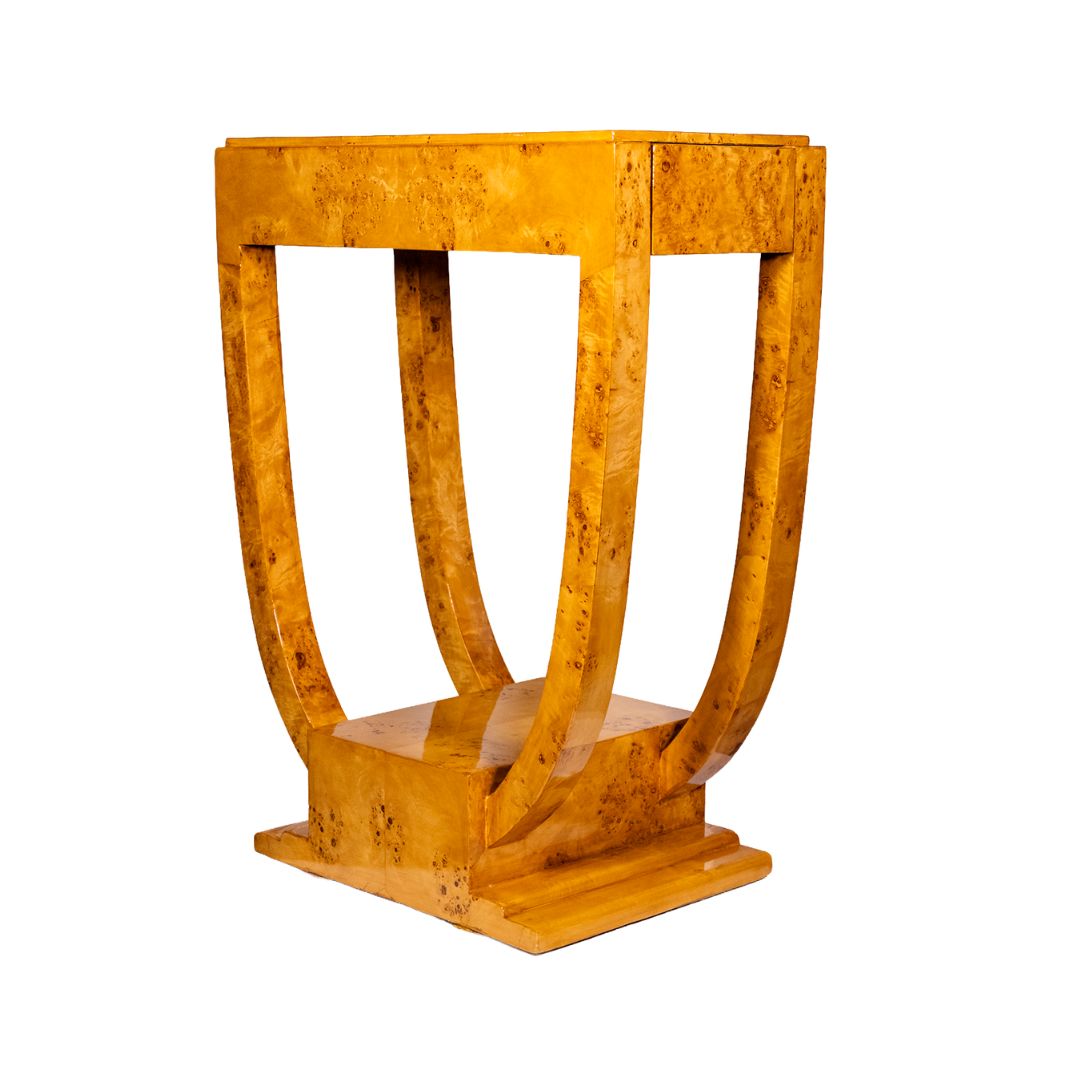
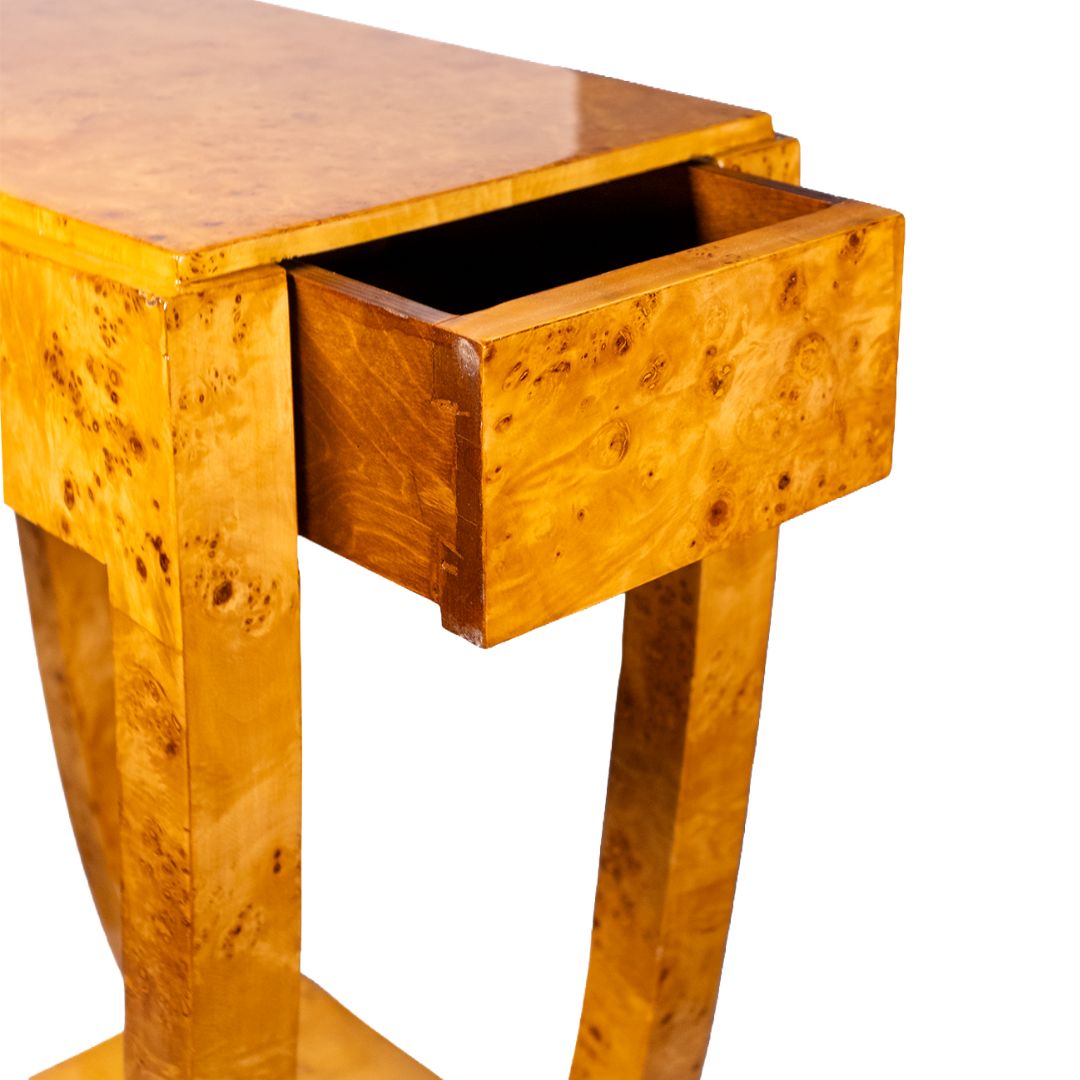
An Art Deco side table is recognised by its geometry, its curving lines and its book-matched burr walnut veneer. In form and finish our tables follow the tradition of French furniture of the 1920s and 1930s. The collection at Kuzco Art Maison is made entirely by hand, by cabinetmakers who have mastered the traditional techniques of veneering.
Our tables stand in carefully designed interior projects and in private drawing rooms. The selection rests on the art history and connoisseurship of Lilly-Ann de Zeeuw, MA, founder of the house, who trained in Museum Studies and in Art, Market and Connoisseurship (UvA and VU). Viewing is by appointment at the Amsterdam and Bleiswijk showrooms, and the tables are shipped insured to any country in Europe.
What sets an Art Deco side table apart
Art Deco is usually associated with Paris in the 1920s. A side table in this style can be identified by a handful of recurring traits.
First, the form. Geometric silhouettes lead: the cylinder, the circle, the octagon, the stepped plinth. Curved legs that meet towards the centre, U-shaped supports, round plinths and black spheres are constructional devices that recur from table to table in this collection.
Next, the wood. In Art Deco furniture the figure of the wood takes the lead, and ornament is reduced to a band of marquetry or a narrow fillet. Almost everything in the collection is veneered in burr walnut; the Nocturne has a top in Macassar ebony.
Finally, the finish. An Art Deco piece owes much of its character to successive rounds of polishing and varnish: each coat deepens the colour a little and calms the surface.
The 1925 Paris Exhibition and the name of the style
The label 'Art Deco' is later than is often thought: the Victoria and Albert Museum dates it to the 1960s. The same museum counts the Exposition internationale des arts décoratifs et industriels modernes, held in Paris in 1925, among the key moments of a style then known as style moderne. Our side tables take up that language of form, but every one is newly made.
The names of the tables (Charleston, Gatsby, Ellington, Coltrane, Speakeasy, Vesper, Ritz) were not chosen as sales gimmicks: they call up the world of jazz, its dances, its clubs and its grand hotels. They do not refer to historical models; they are the collection's own names.
The craft: burr walnut veneer, ebony details and a gloss varnish
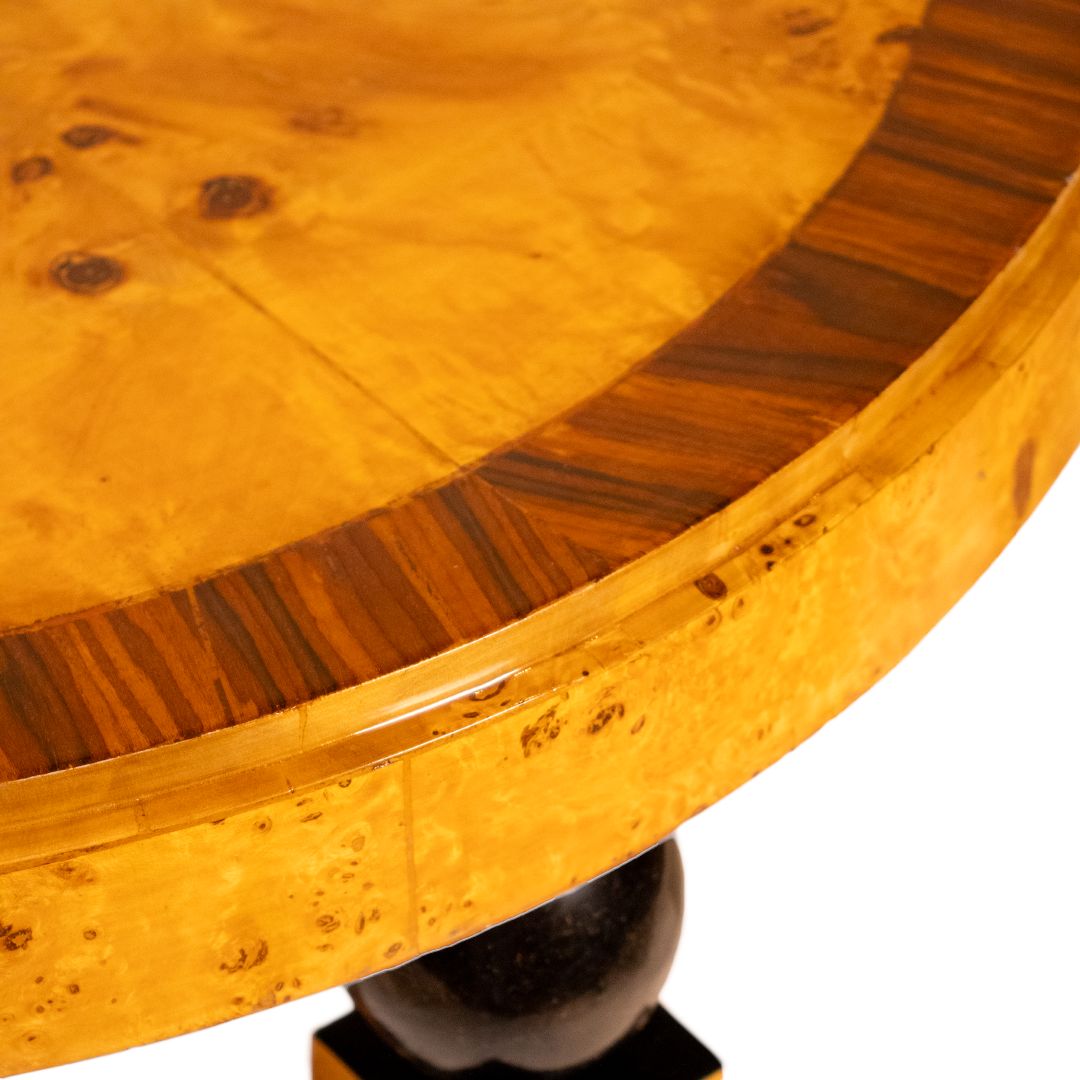
The main wood in the collection is burr walnut veneer, taken from the root area of the tree. It is one of the most prized and scarce parts of the walnut, recognised by its irregular figure of small knots and ripples. It is the same figured wood still found on the dashboards of some fine motor cars.
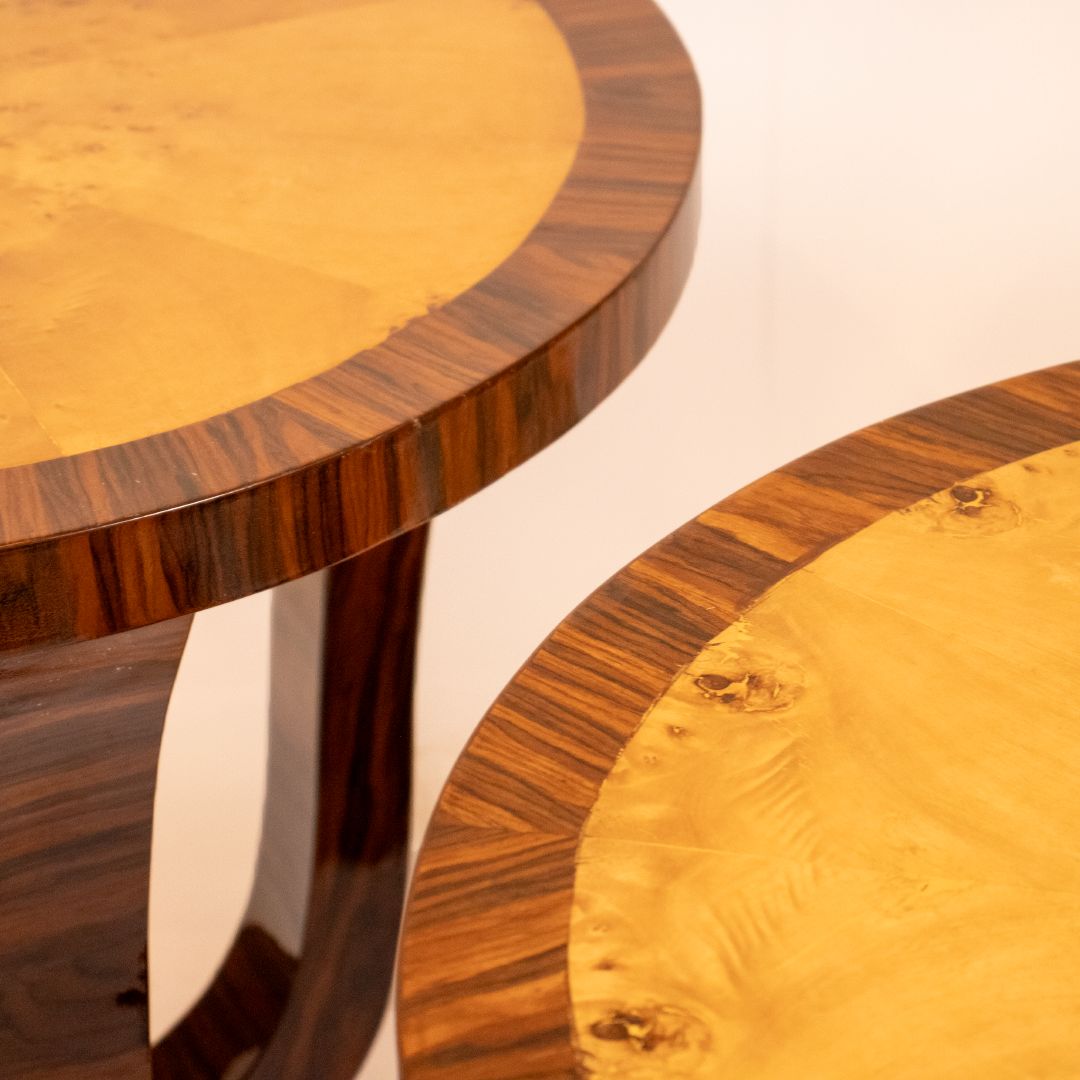
It is worked as veneer rather than solid wood because the burr grows unpredictably and rarely yields solid boards of sufficient size. Veneering, cutting thin leaves and laying them in mirror image on a stable core, reveals the whole figure. On our tops it shows as continuous, often symmetrical patterns that cover the entire surface. This book-matching takes patience and a good eye: one wrong cut and the pattern no longer meets.
Alongside the burr walnut, ebony details supply the dark lines. The finish is a gloss varnish, built up coat by coat, which warms the tone of the wood and brings out the ripples of the burr. It is a conscious choice: the aim is not to make the table look old but to give the figure the calm and depth of a well-kept Art Deco piece. The result has none of the chill of the brand-new, only a warm tone.
Our Art Deco side tables, model by model
The collection is composed the way an interior is approached: first the silhouette and proportion, then the relationship with the seating, the rug and the pictures on the wall. Most pieces are veneered in burr walnut, with details in ebony or black lacquer. One model changes wood: the Nocturne, in Macassar ebony.
Round Art Deco side tables
The round form dominates the collection: almost every table has a circular top.
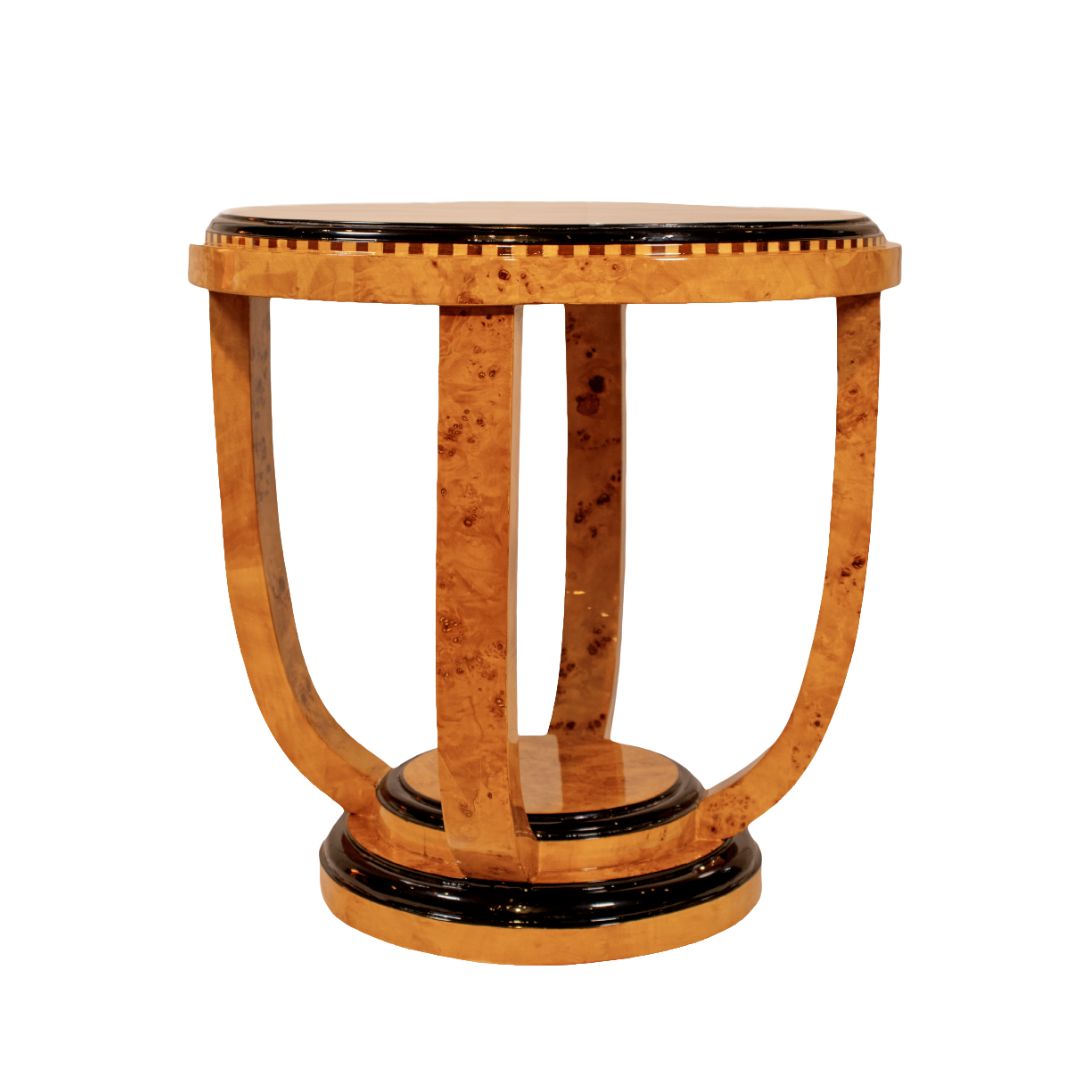
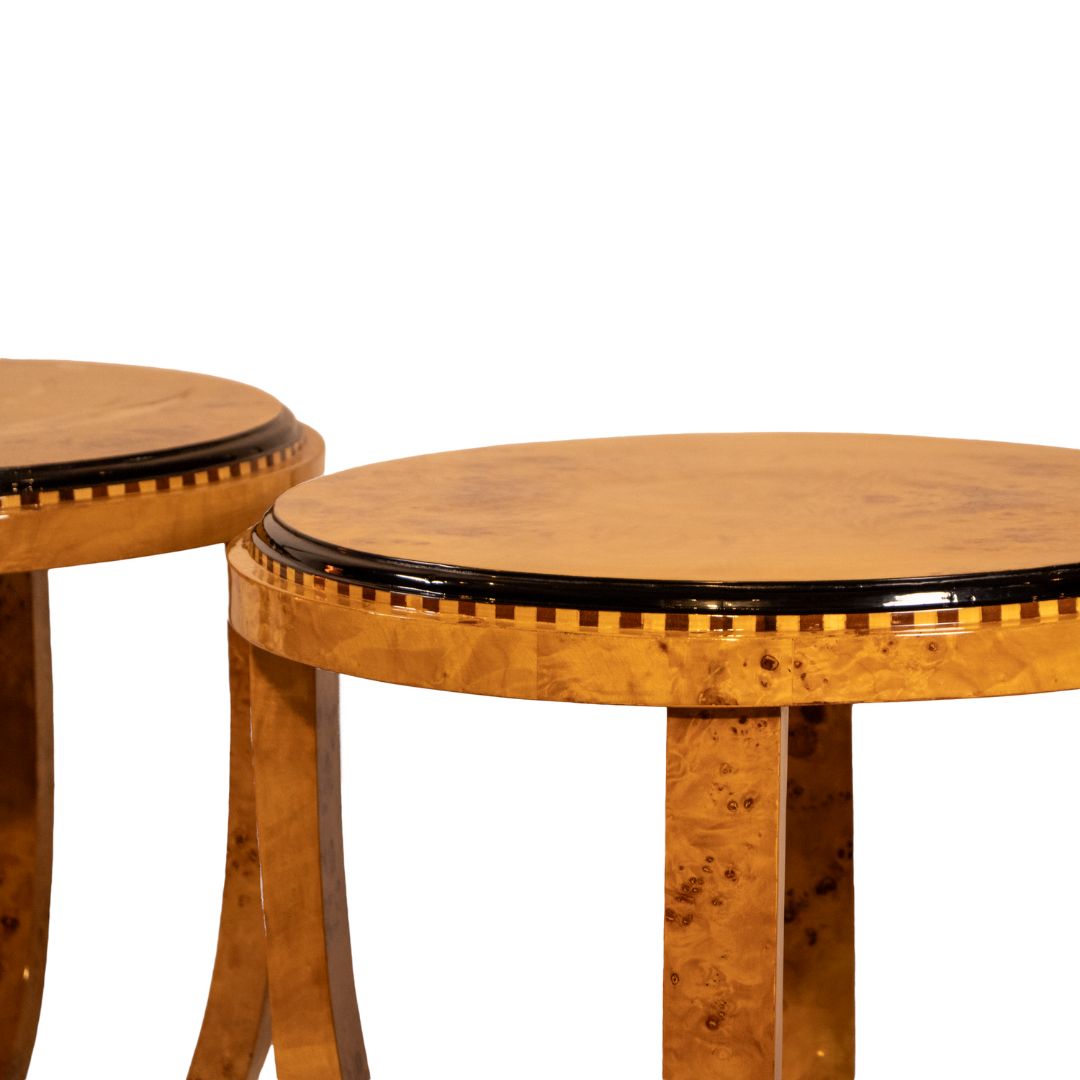
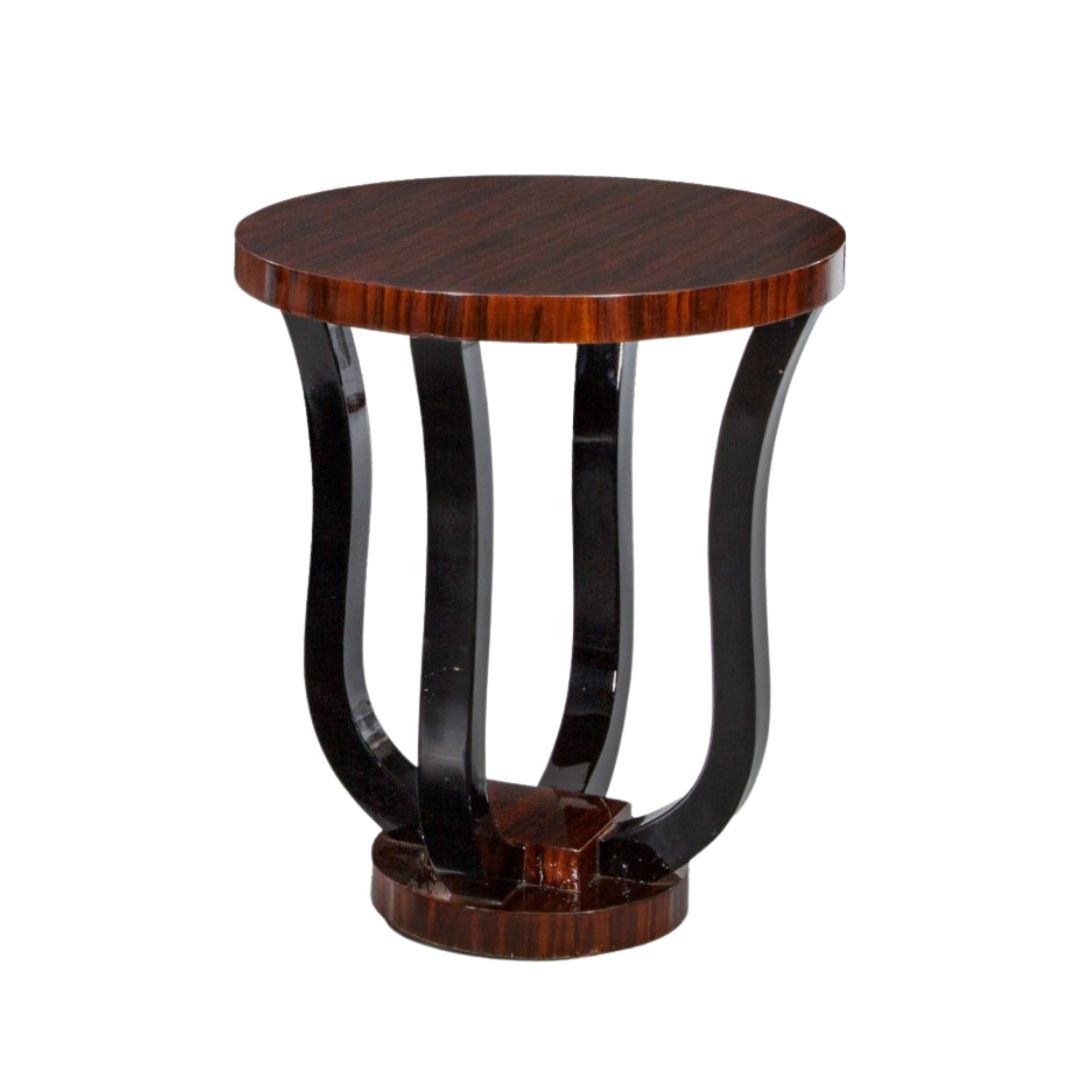
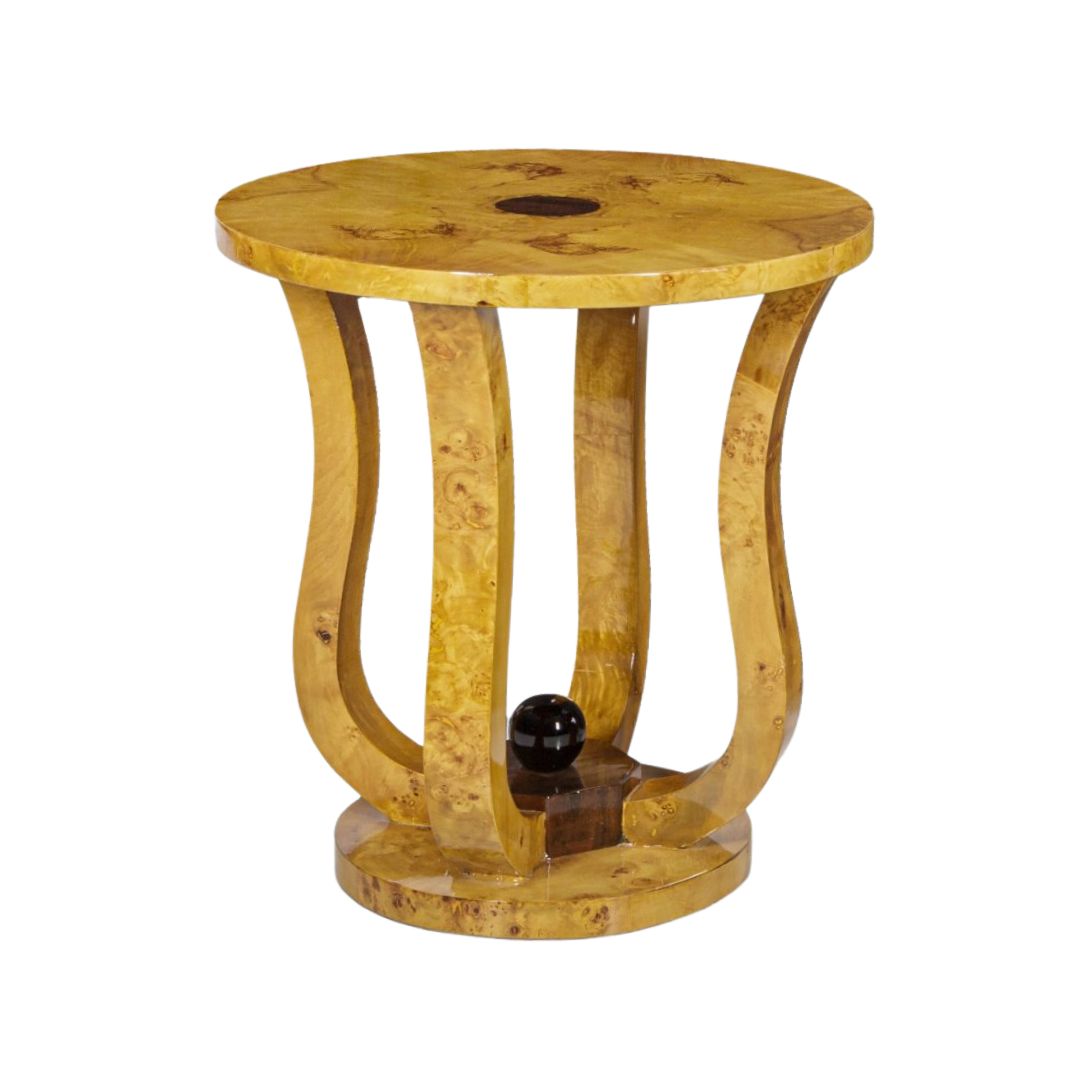
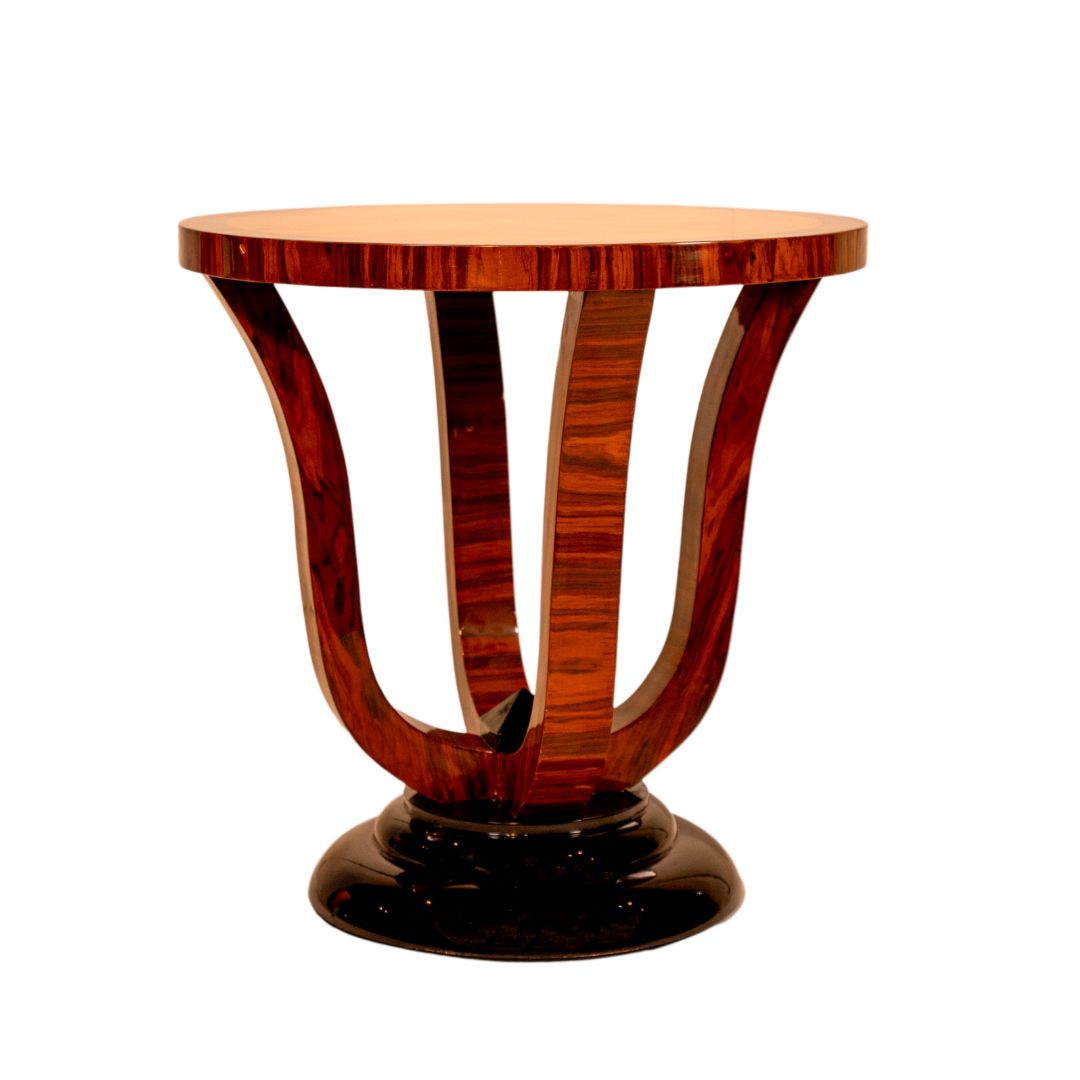
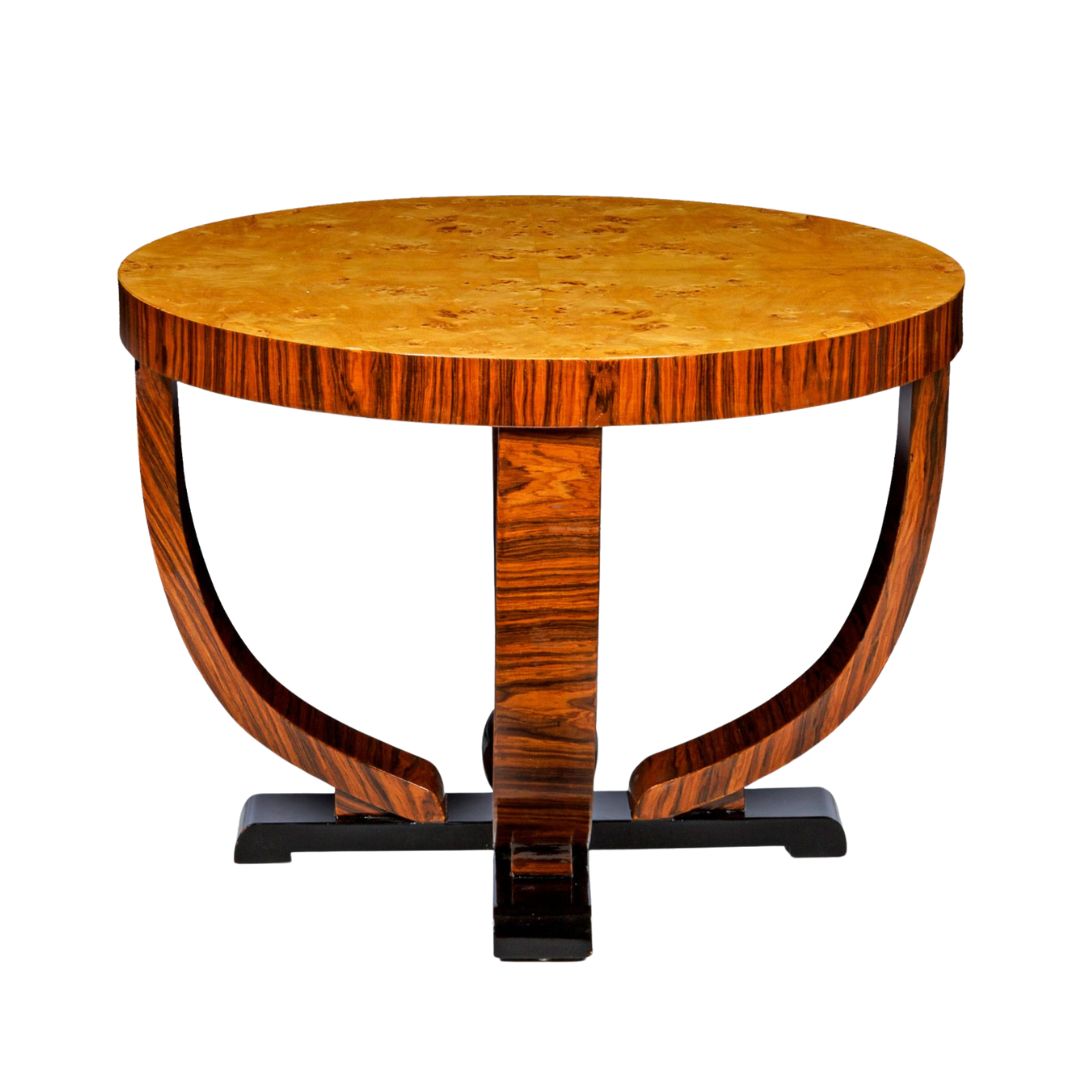
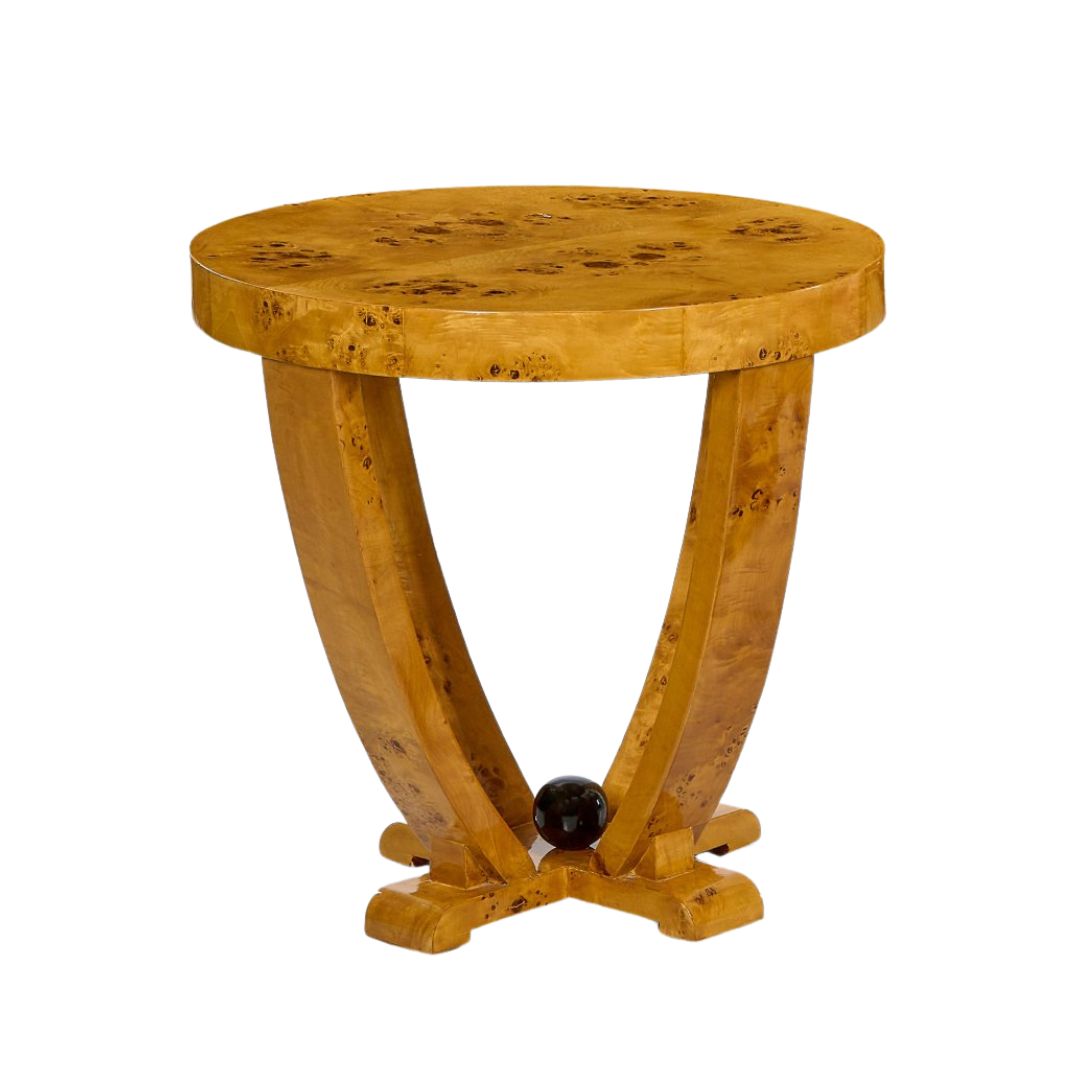
The Coltrane combines a honey-coloured burr walnut centre with a wide band of reddish striped veneer, and its legs, opening like a tulip, run down to a stepped ebony base. The Ellington rests on four flat legs that curve down to a round, two-tier base; its top is framed by a black-lacquered moulding and an inlaid chequer band. The Miller and the Nocturne have a calmer figure and a light base: the first swelling burr legs around an ebony sphere, the second a Macassar ebony top on curved legs lacquered black. The Charleston shows the most burr walnut of all: top, edge and legs in pale wood, with a single ebony sphere on its cross-shaped base. The Speakeasy, with its black cross base, often serves as a round coffee table; since symmetry heightens the Art Deco effect, it is often placed in pairs.
Side tables with a sculptural base
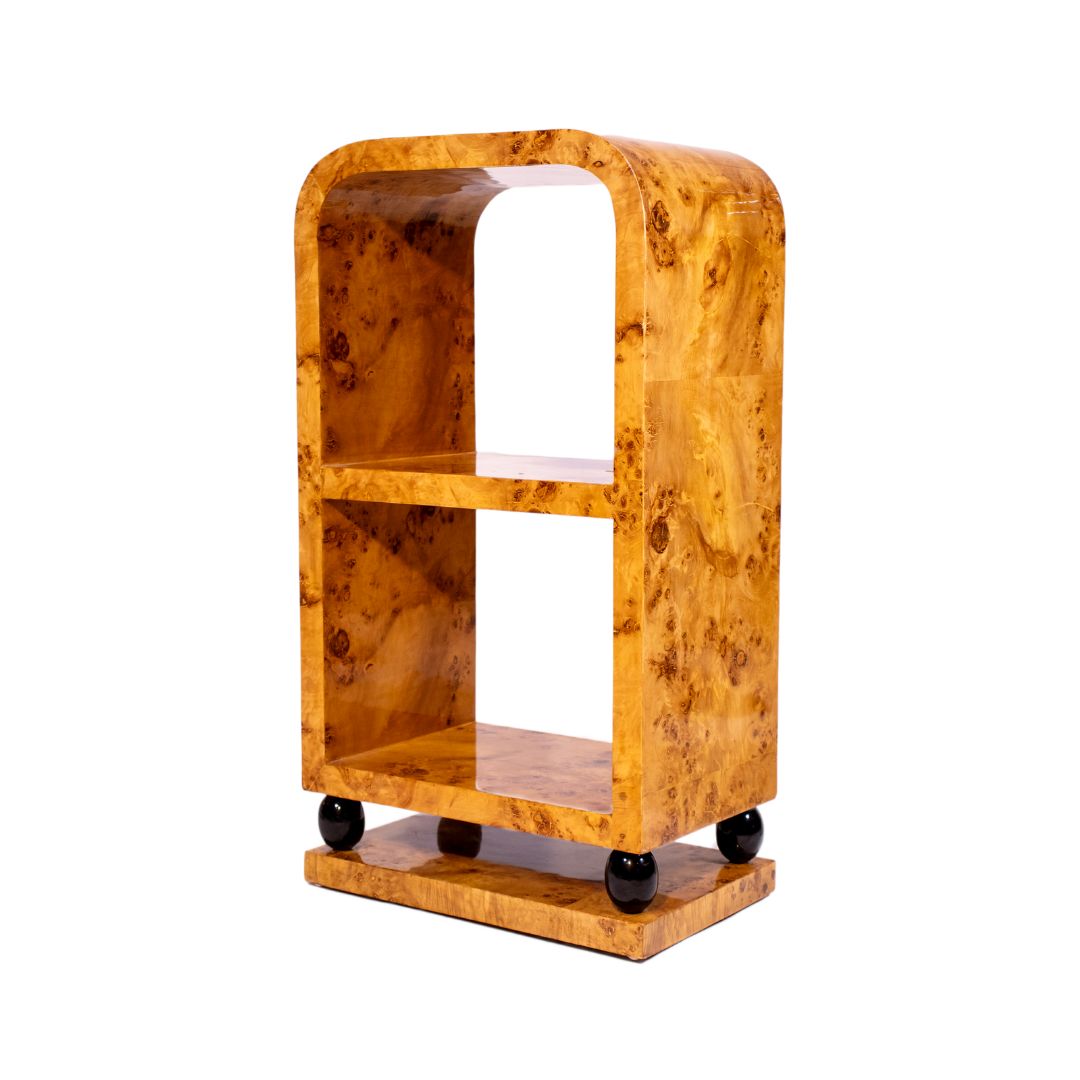
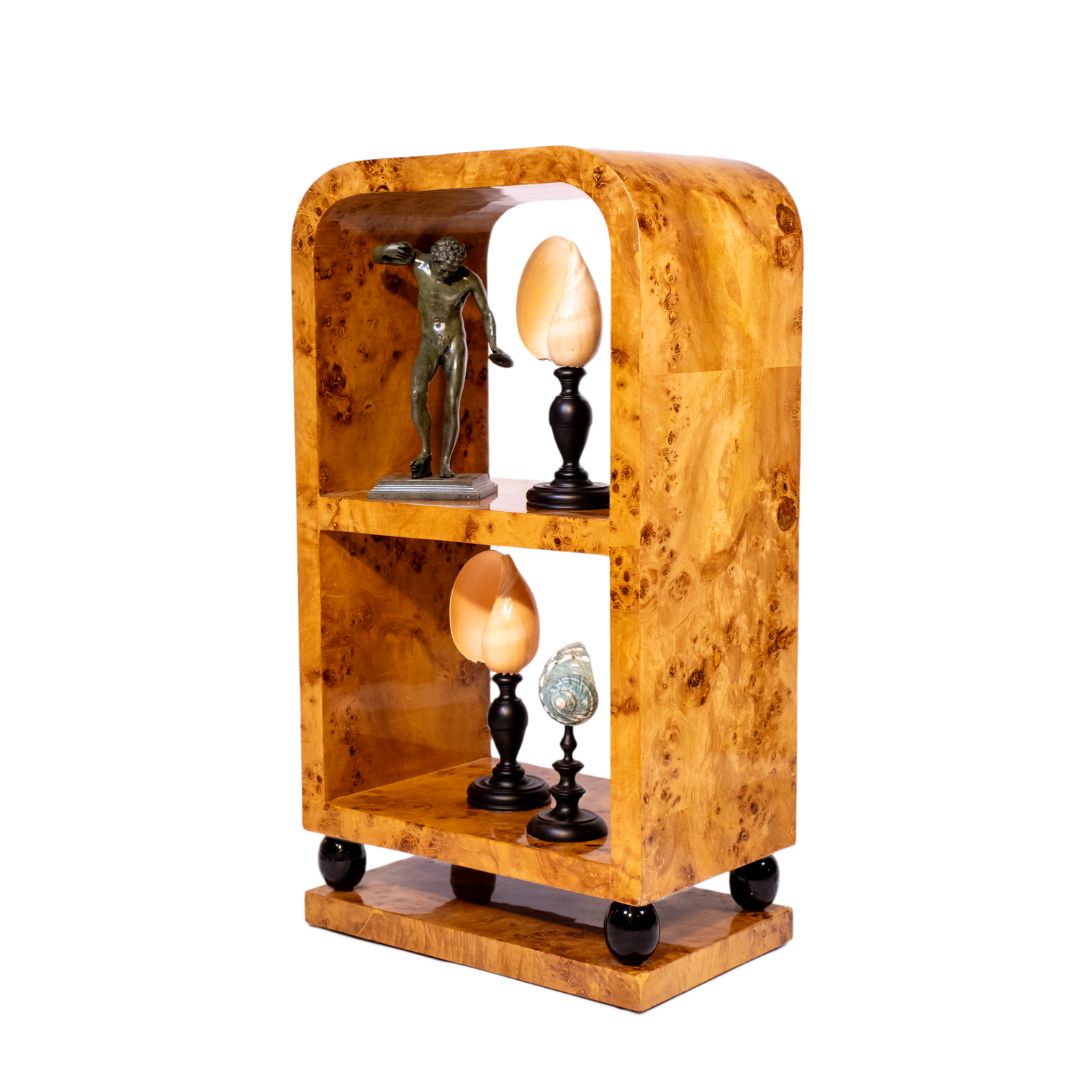
Other tables, round or not, stand out above all for their base and act as a point of attention beside an armchair or a sofa. Three pieces have a straight-sided plan: the square Montclair; the Calloway, rectangular and shallow, with drawers at both ends; and the Savoy side cabinet, with two open tiers.
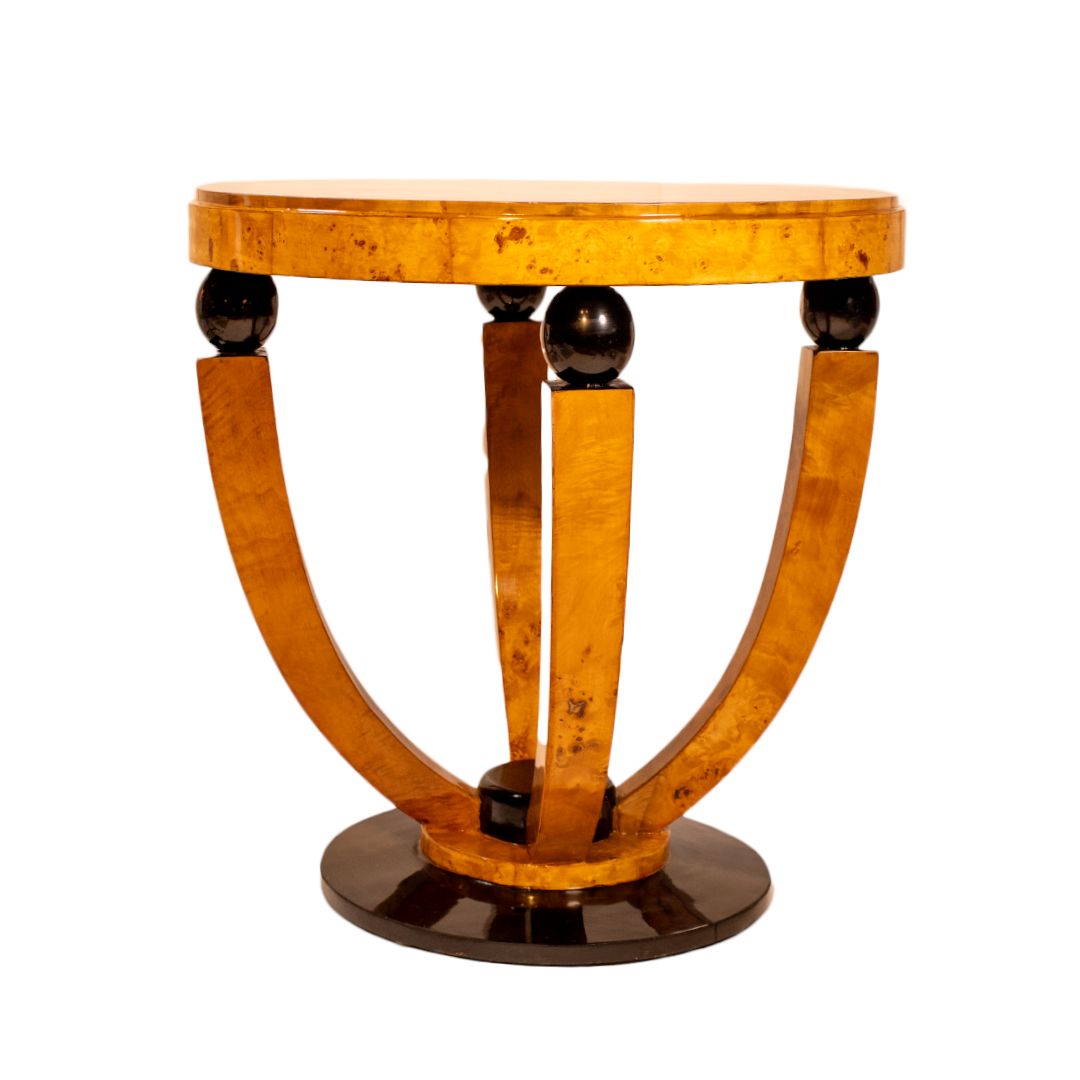
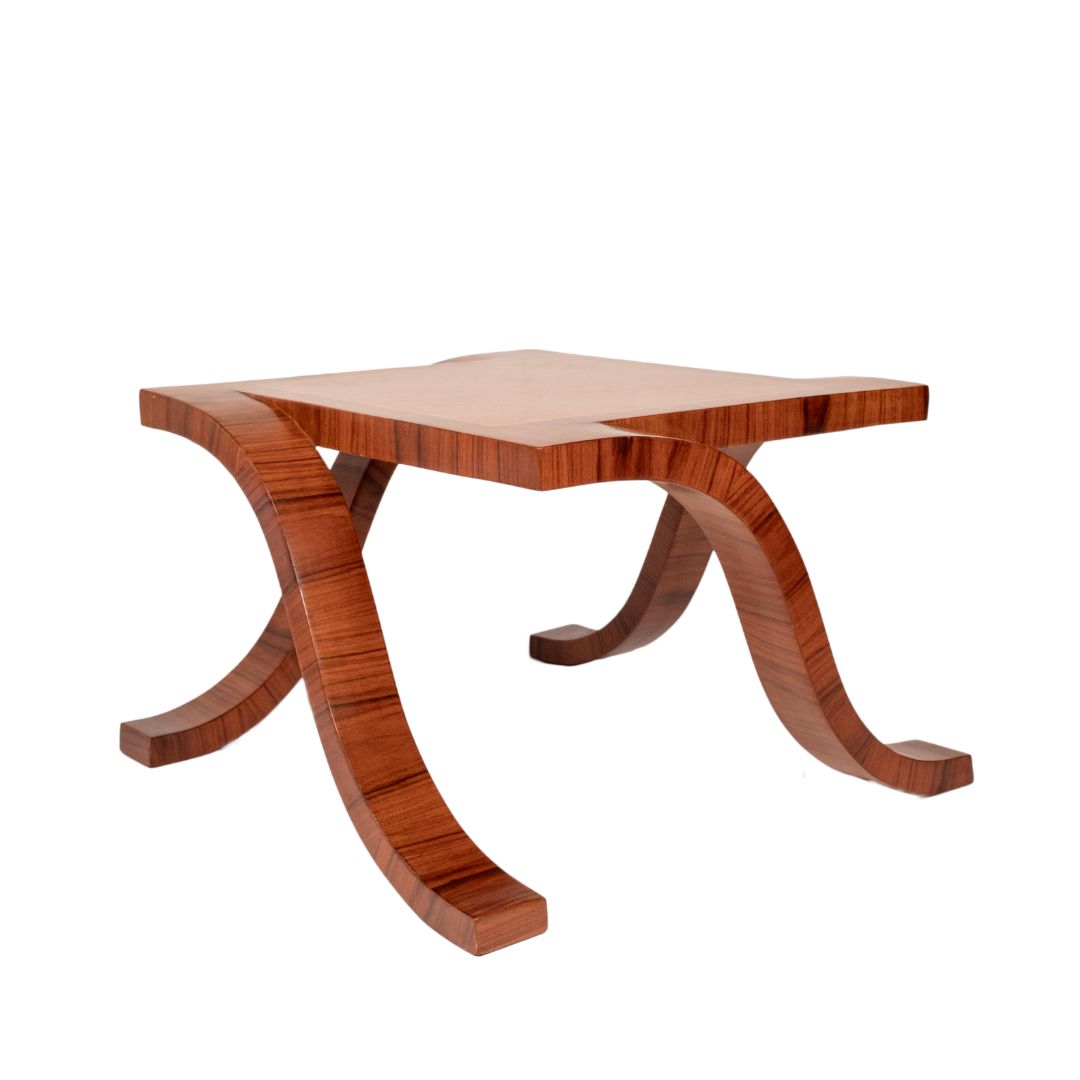
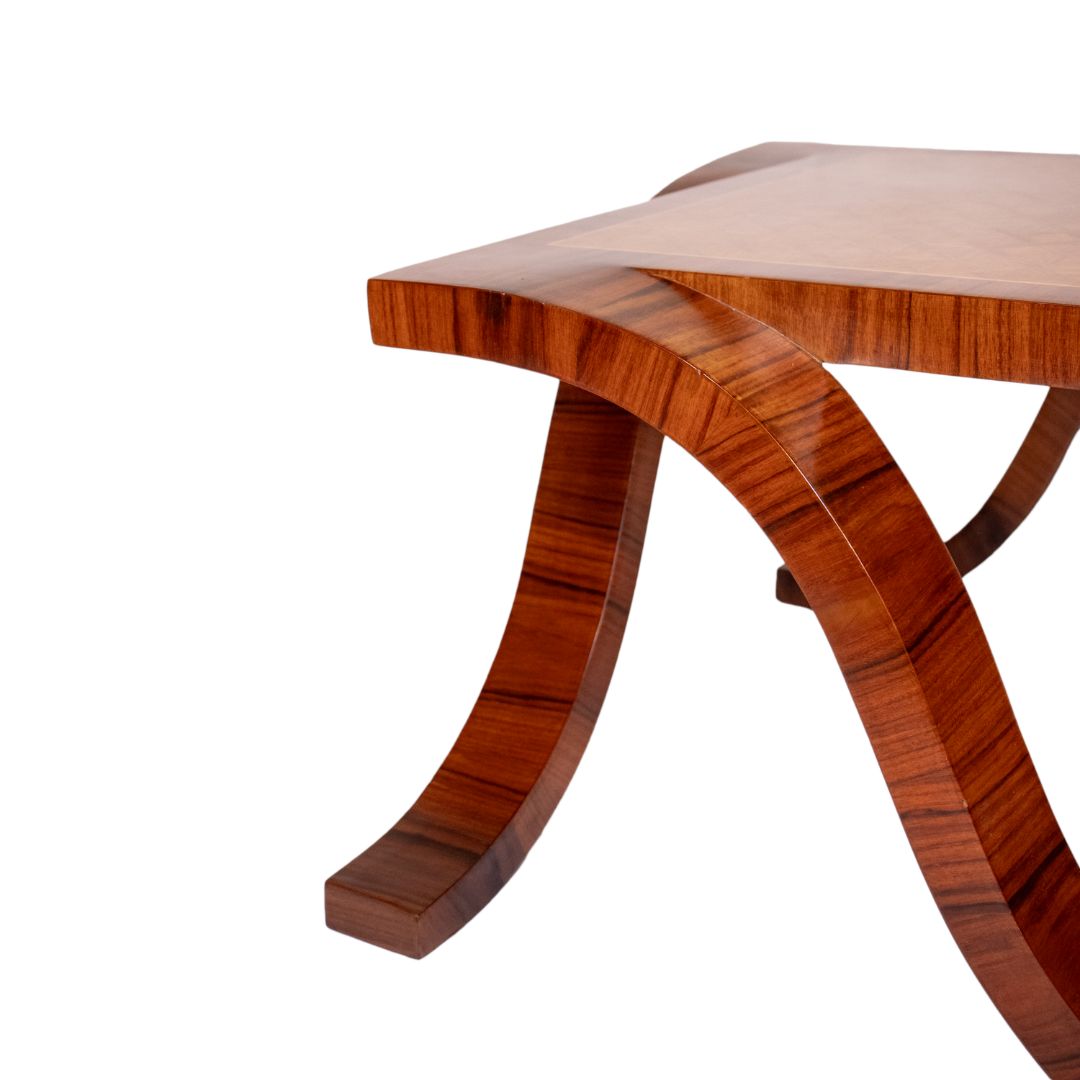
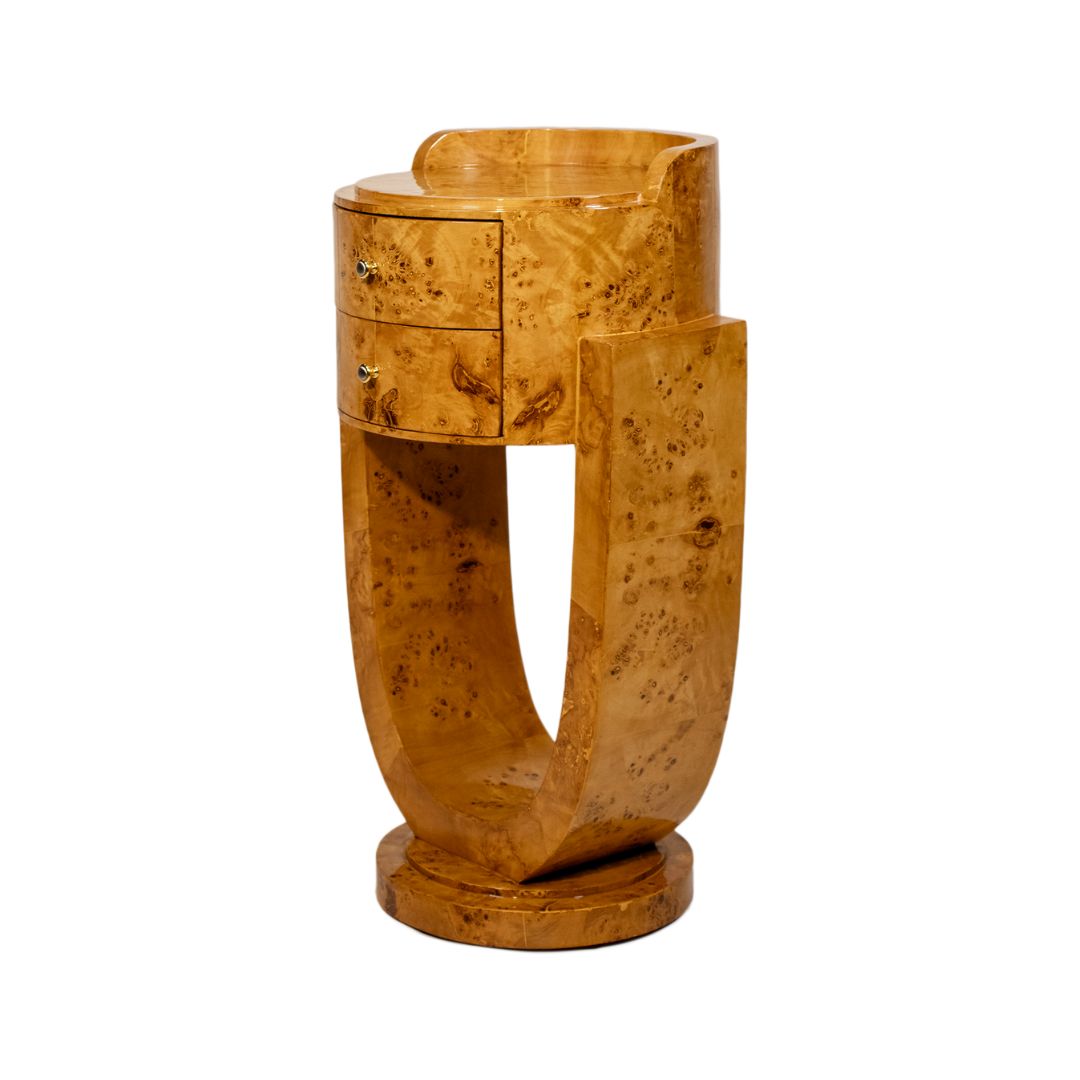
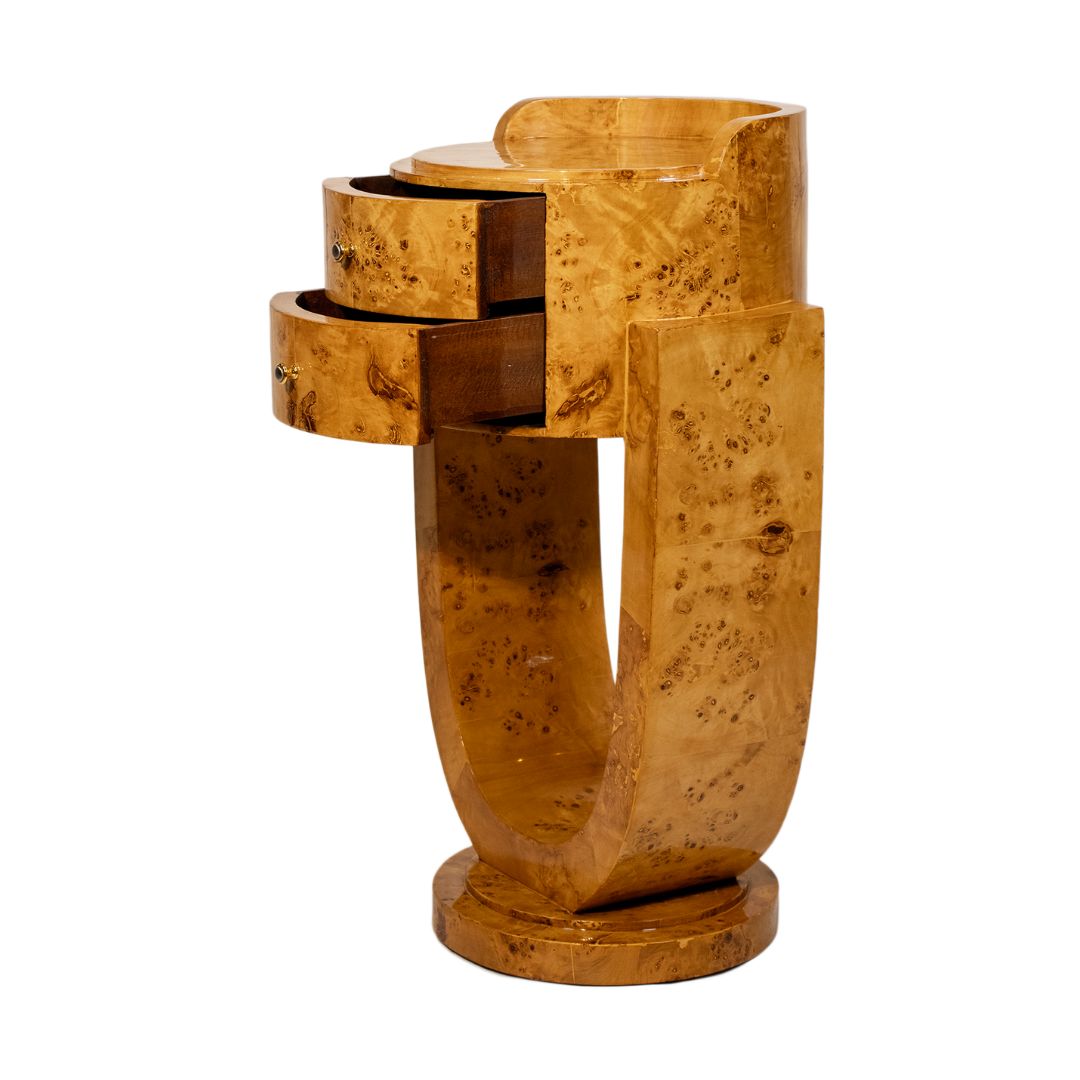
The Gatsby takes its name from Fitzgerald's novel; its burr walnut top rests on curved legs lacquered black, each crowned at the top by a sphere. The Flapper, named after the modern young women of the 1920s, frames its round top with a band of dark red wood and carries black spheres at the head of its burr legs, which stand on a black disc. The Ritz and the Montclair play with the tension and balance of curved legs, a device both functional and architectural: on the first they gather below in a central block; on the second, S-curved, they rise to each corner of the top. The Darcy stands on a U-shaped support and holds, in its cylindrical body, two curved-front drawers for jewellery, reading glasses or letters.
Art Deco side tables for the sitting room and beyond
An Art Deco side table works in classical and modern interiors alike. In a minimal space it adds sculptural volume and visual weight; in an eclectic one it links pieces from different periods. In hotels the tables show best in lobbies, suites and lounges, where the figure of the veneer can really be appreciated. In homes they stand beside deep sofas, in reading corners and near the fireplace.
A round side table can serve as a stand for a bronze sculpture or a Chinese porcelain ginger jar. Two identical tables, placed symmetrically, can flank a chimneypiece or a bed. And a veneered top paired with a plain rug lets the figure of the wood take the lead.
Frequently asked questions about Art Deco side tables
Are these antique Art Deco tables or newly made?
They are newly made, with a carefully worked varnished finish: new, then, but with forms and woods that refer to the Parisian Art Deco tradition. A period Art Deco piece signed by a cabinetmaker such as Ruhlmann belongs to another market and another price bracket: it is scarce and fragile. These tables come close to the atmosphere and depth of that period while suiting present-day interior projects in use and in price.
What is the difference between burr walnut and ordinary walnut?
Burr walnut (in French, loupe de noyer) comes from the root or the base of the walnut trunk, where the wood grows irregularly and the fibres twist into swirls and knots. Ordinary walnut comes from the straight part of the trunk and has a quiet, fairly linear grain. Burr is therefore scarcer and more decorative, and it is almost always used as veneer, since it seldom yields solid pieces large enough.
Is a veneered table inferior to a solid wood one?
Not with this kind of furniture. With burr walnut and Macassar ebony, veneer is the usual way of working: only then does the figure show complete and symmetrical, book-matched, and the piece stays stable through changes in humidity. Quality lies in the core, in the thickness and source of the veneer and in the skill with which it is laid. Veneer also keeps the tables easy to move and not overly heavy.
How can an Art Deco side table fit into a modern interior?
Place it beside a sofa, in an alcove or, as a pair, on either side of the chimneypiece. Pair it with a plain rug and keep objects to a minimum: a lamp or a Chinese porcelain jar is enough. The figure of the veneer does the rest.
Which Art Deco side table works best beside a sofa?
Beside a sofa the usual choice is a height of 50 to 60 cm, level with the arm or slightly above, and a top 40 to 50 cm across. Our round models Coltrane, Ellington and Miller stand between 58 and 64 cm high: compare that with the arm height of the sofa. For deeper or larger sofas the Gatsby or the Flapper are often more suitable, as they carry more visual weight. When in doubt, send photographs of the room and we will advise.
How should veneered Art Deco furniture be cared for?
Dust often with a soft, dry cloth, following the grain. Avoid silicone sprays: they leave a haze on the finish. For light cleaning a barely damp cloth is enough; dry the surface at once. Do not put hot or wet glasses straight onto the wood, and always use a coaster. Avoid long periods of direct sun too, as it can fade the colour of the wood. Once a year, a furniture wax with a natural base keeps the sheen.
Are Art Deco side tables suitable for hotels and interior projects?
Yes, provided scale and placement are right. In hotels they work especially well in lobbies, suites, lounges and reception areas, where the figure of the veneer and the gloss of the varnish give the space depth from the first moment. Projects are supplied regularly in which the side table is part of the interior as a whole rather than decoration. For projects, material samples and high-resolution product photographs are available on request.
Are the tables also sold to private clients?
Yes. Kuzco Art Maison began as a digital-first B2B wholesaler, but the tables are also available to private clients. For them the recommended retail price applies; trade clients receive B2B pricing. Private clients are welcome at the showrooms in Amsterdam and Bleiswijk by appointment.
What is the difference between an Art Deco side table, coffee table and console table?
A side table stands beside or behind a seat (sofa, armchair) and usually measures 50 to 65 cm high, with a small top. A coffee table takes the centre, in front of the sofa; it is lower (35–45 cm) and wider. A console table or wall table stands against a wall or in the hall; it is narrow and tall (75–90 cm). In our collection, models such as the Charleston and the Ellington are side tables; the Coltrane and the Speakeasy often serve as coffee tables, and the Vesper and the Armstrong are console tables.
How is an Art Deco side table packed and shipped?
Veneered furniture calls for care. The top, edges and base are protected on all sides, with particular attention to pressure points and corners. Within Europe, shipments are insured and tracked, and for large or delicate orders the transport conditions are agreed in advance. Wherever possible, Art Deco furniture travels on a pallet: in our experience the safest way to ship it.
Can the Art Deco side tables be seen in a showroom?
Yes, in the showroom in Bleiswijk. Interior professionals receive help choosing, combining and placing the pieces within the project, so that the side table does not end up 'anywhere' but truly completes the space. For personal advice, write, call or book an appointment.
Craftsmanship – our Art Deco side tables are built by hand in burr walnut veneer, ebony and related woods, with the care and proportions of traditional cabinetmaking.
Knowledge of styles – the collection rests on art-historical study of the 1925 Paris Exhibition and of French Art Deco furniture.
Made to order – we work with artists, museums and interior designers on made-to-order pieces in the Art Deco style.
Service – showrooms in Amsterdam and Bleiswijk, insured shipping within Europe and personal advice for private purchases and projects alike.