
Museum Grand Tour
You have just scanned a QR code next to an object in the Rijksmuseum van Oudheden, the National Museum of Antiquities in Leiden. What you see in front of you is a Museum Grand Tour souvenir, carved or cast by hand using the same techniques that produced the original centuries ago. It is for sale. And with half of what you pay, you support the museum.
This page explains where that tradition comes from, how the pieces are made, and what exactly you are buying.
Key takeaways
- The Grand Tour was the European educational journey to Rome, Naples and Athens (17th–19th century). Travellers brought home purpose-made reproductions: miniature temples, bronze casts, obelisks.
- 50% of every purchase goes directly to the Rijksmuseum van Oudheden, funding restoration, new acquisitions and research.
- Every piece is handmade in solid marble, granite, bronze (lost-wax method) or hand-painted porcelain. No plastic, no machines.
- Every piece carries two dates: the year of the original and the year it was remade.
- You receive a personal certificate with the story of the original, your name and the museum's thanks.
Contents
- What was the Grand Tour?
- The Museum Grand Tour: KUZCO x RMO
- Supporting the museum: how the 50% works
- The collection, piece by piece
- Material and craftsmanship: why no plastic
- About KUZCO Art Maison
- Frequently asked questions
What was the Grand Tour?
The Grand Tour was the journey that wealthy Europeans made between the seventeenth and nineteenth centuries to see antiquity with their own eyes. The route took in places such as Rome, Naples and Athens. It was no holiday: it was a formative journey on which young adults discovered the classical world.
That journey was called the Grand Tour. Those who returned brought something back: a miniature marble temple, a bronze cast, a pair of obelisks. Not plunder, but purpose-made reproductions, carved and cast to order by workshops. At home on the mantelpiece, they showed where you had been.
Those workshops were no sideline. In Rome, Naples and Florence, entire studios worked for this market alone: sculptors, bronze founders and stonemasons who reduced an ancient statue to something that fitted in a travelling trunk. The Fauno danzante from the Uffizi, Canova's lions in St Peter's, the Temple of Vespasian on the Forum: these were bestsellers even then.
The Rijksmuseum van Oudheden itself grew out of that same movement. When Caspar Reuvens, the world's first professor of archaeology, bought plaster casts of the Parthenon marbles for Leiden in 1820, he did exactly what the Grand Tour traveller did, only on a museum scale: the original stayed where it was, and the form travelled.
The Museum Grand Tour: KUZCO x Rijksmuseum van Oudheden
This collaboration between the Amsterdam atelier KUZCO Art Maison and the Rijksmuseum van Oudheden, the National Museum of Antiquities, builds on that history. Handmade pieces in marble, bronze, granite and porcelain, entirely carved, cast and painted according to centuries-old traditions. Every piece for sale in the shop states the year of the original and the year it was remade.
A Grand Tour piece was never meant to pass for an antique. It was meant to hold on to a memory.
Support the museum, and take antiquity home
The Museum Grand Tour pieces are for sale. From every sale, 50% of your purchase price goes to the Rijksmuseum van Oudheden, funding restoration, new acquisitions and research. The other 50% goes to the atelier and the artists who made the piece.
In return, you receive your own Museum Grand Tour souvenir with a personal certificate: the story of the original, your name, and the museum's thanks.
Take it with you or have it delivered
- Take it home today. Everything can be paid for on the spot and taken with you.
- Home delivery. You can also pay now and contact KUZCO afterwards to arrange delivery. This carries an additional charge, set by KUZCO.
- Worldwide. Shipping is available within the Netherlands and abroad.
The collection, piece by piece
Colossal Foot with Sandal — €1,120
KM0049 · Original: probably 16th–17th century, made to complete a Roman statue · Remade: 2026
After the Colossal Marble Foot, Rijksmuseum van Oudheden, inv. Pb 144
Hand-carved white marble with grey veining · H 31 · L 50 · W 21 cm · 20 kg
The original is part of the RMO collection. It came to this museum in 1818 via the seventeenth-century collection of the Reynst brothers and the Van Papenbroek bequest, and it is probably not antique. The RMO regards it as an early modern addition to a Roman statue. It is a highlight all the same, precisely because that addition shows how earlier generations dealt with antiquity.
Hand-carved in solid marble by KUZCO Art Maison, Amsterdam. 50% of your purchase price goes to this museum.
View the Colossal Marble Foot with Sandal
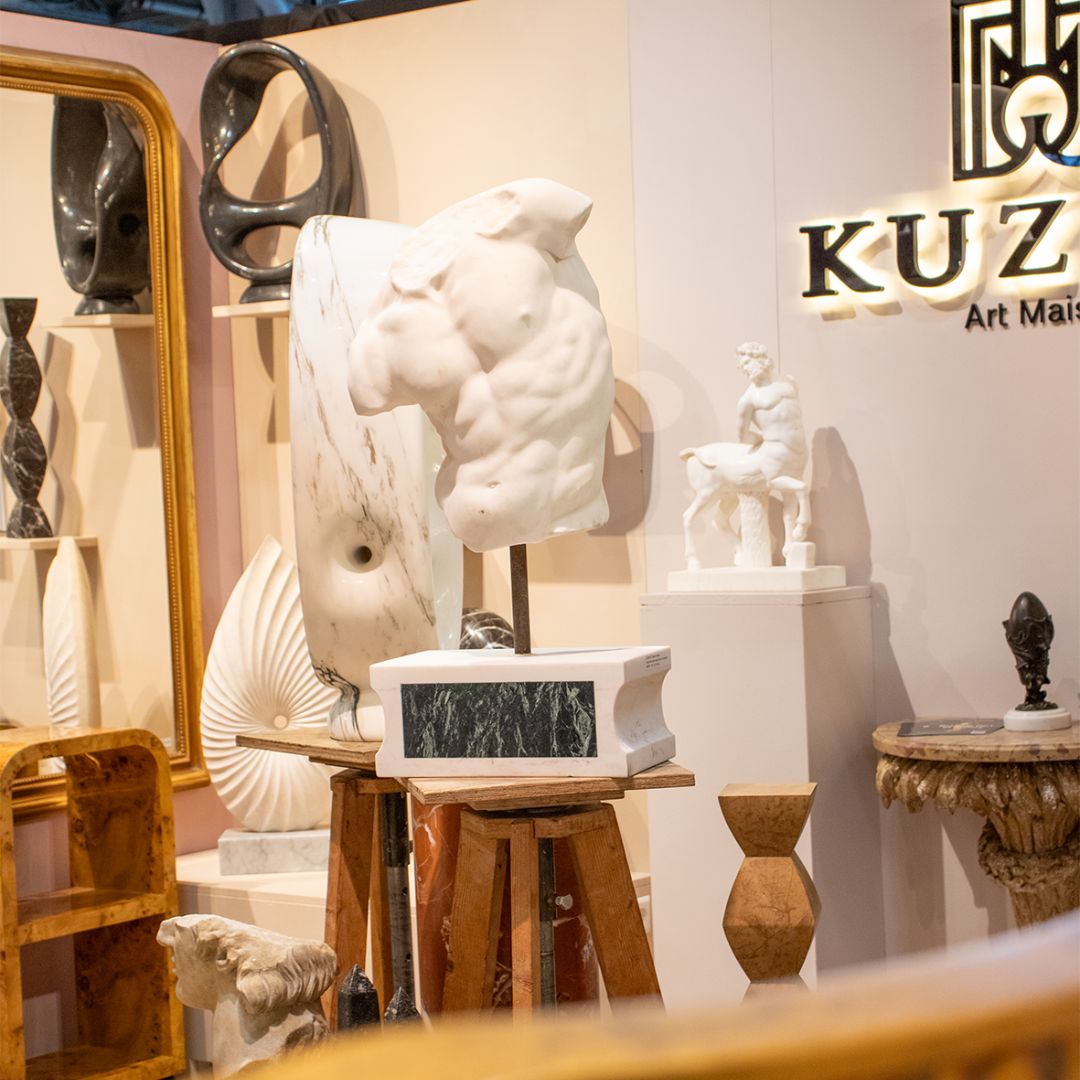
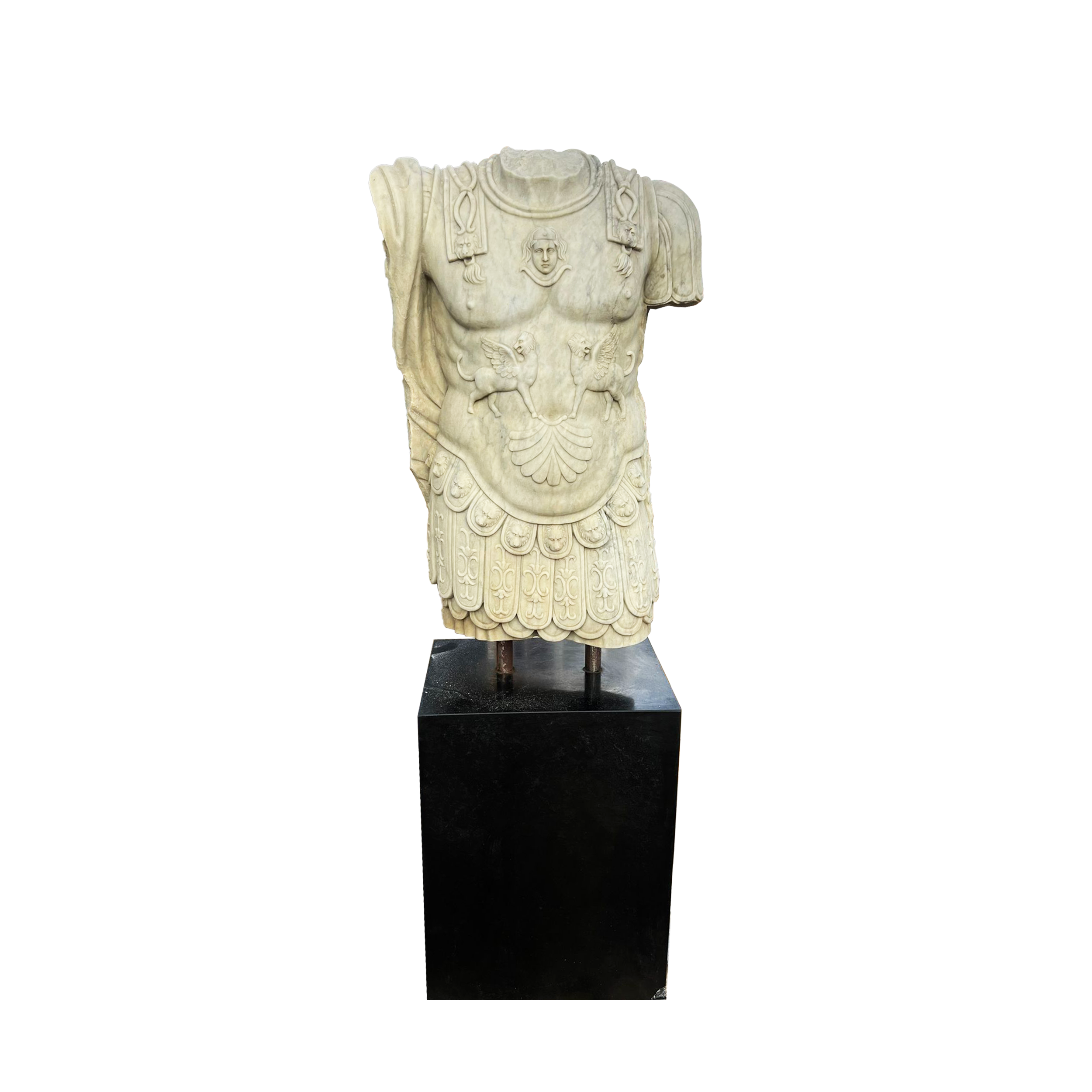
Roman Torso with Cuirass and Paludamentum — €2,450
KM0041 · Original: c. 20 BC (Prima Porta type) · Remade: 2026
After the type of the Augustus of Prima Porta, Musei Vaticani
Hand-carved white marble with antique finish on a travertine base · H 85 cm · 60 kg
The anatomical breastplate (lorica musculata) with mythological relief and the ceremonial cloak over the left shoulder (paludamentum) were reserved for generals and emperors. One glance at the breastplate told a Roman exactly who he was dealing with. The most famous example of the type is the Augustus of Prima Porta in the Vatican Museums. The RMO holds fine examples too.
Hand-carved in solid marble by KUZCO Art Maison, Amsterdam. 50% of your purchase price goes to this museum.
View the Roman Cuirassed Torso with Paludamentum
Temple of Vespasian and Titus — €2,850
KM0016 · Original: built AD 79–87 · Remade: 2026
After the remains on the Forum Romanum, Rome
Hand-carved white marble on a black marble plinth · H 63 · L 24 · W 24 cm · 20 kg
Three Corinthian columns of this temple still stand on the Forum Romanum, together with a section of the entablature. Marble architectural models like this were the Grand Tour souvenir: not a picture, but a building you could hold. Those who came home put Rome on the mantelpiece: to scale, in stone, ruin included.
Hand-carved in solid marble by KUZCO Art Maison, Amsterdam. 50% of your purchase price goes to this museum.
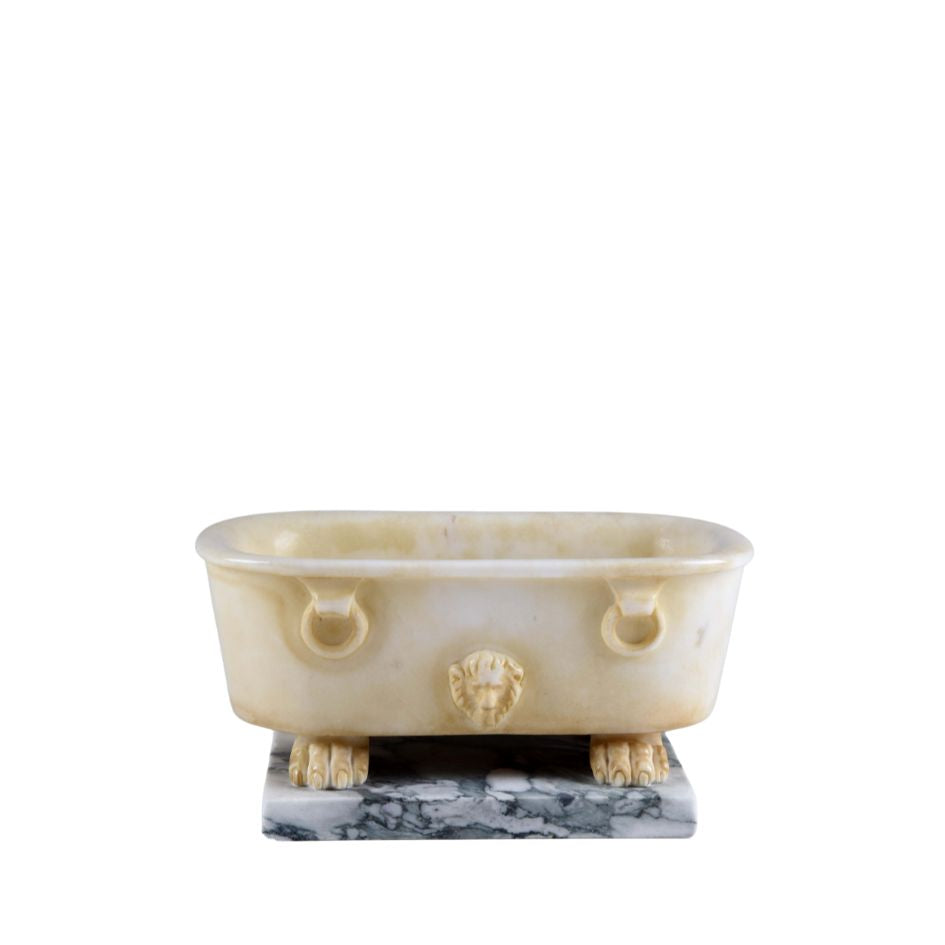
Roman Marble Bath in Grand Tour Style — €1,250
KM0017 · Original: Roman labrum, 1st–3rd century AD; as a souvenir 18th–19th century · Remade: 2026
After the Roman labrum, the stone water basin of ancient bathing culture
Hand-carved white marble with green veining on a black marble base · H 8 · L 19 · W 8.5 cm · 5 kg
Lion masks, ring handles, claw feet: every feature of the ancient labrum, reduced to living-room scale. Miniature baths like this were much-loved Grand Tour souvenirs. They brought home not just a shape but a whole idea: that bathing in Rome was a public, architectural affair. Can be used as a decorative bowl.
Hand-carved in solid marble by KUZCO Art Maison, Amsterdam. 50% of your purchase price goes to this museum.
Cobra Relief — €760
KM0048 · Original: Late Period–Ptolemaic, c. 664–30 BC · Remade: 2026
After a relief plaque with a cobra, The Metropolitan Museum of Art
Hand-carved white marble with antique finish · H 28 cm · 7 kg
The rearing cobra with spread hood is the uraeus: the goddess Wadjet, who stared down the pharaoh's enemies from his brow. Egyptologists call reliefs of this type sculptors' models or votives: not a finished product, but practice piece and offering in one. They were given to temples. A reproduction that was itself a gift.
Hand-carved in solid marble by KUZCO Art Maison, Amsterdam. 50% of your purchase price goes to this museum.
Granite Obelisks — Pair — €1,200
KM0028 · Original: Egyptian obelisks, 2nd millennium BC; as a Grand Tour type 18th–19th century · Remade: 2026
After the Grand Tour type in Egyptian hardstone
Hand-carved Black Impala and Balmoral Red granite · H 60 · L 9 · W 9 cm · 30 kg (pair)
Rome has more Egyptian obelisks than Egypt itself: emperors had them shipped across the sea as proof of conquest. Grand Tour travellers repeated that gesture at tabletop size, preferably in polished hardstone that imitates Egyptian granite. An obelisk has always been an object moved from one place to another to prove a point.
Hand-carved in solid granite by KUZCO Art Maison, Amsterdam. 50% of your purchase price goes to this museum.
View the Grand Tour style sculptures
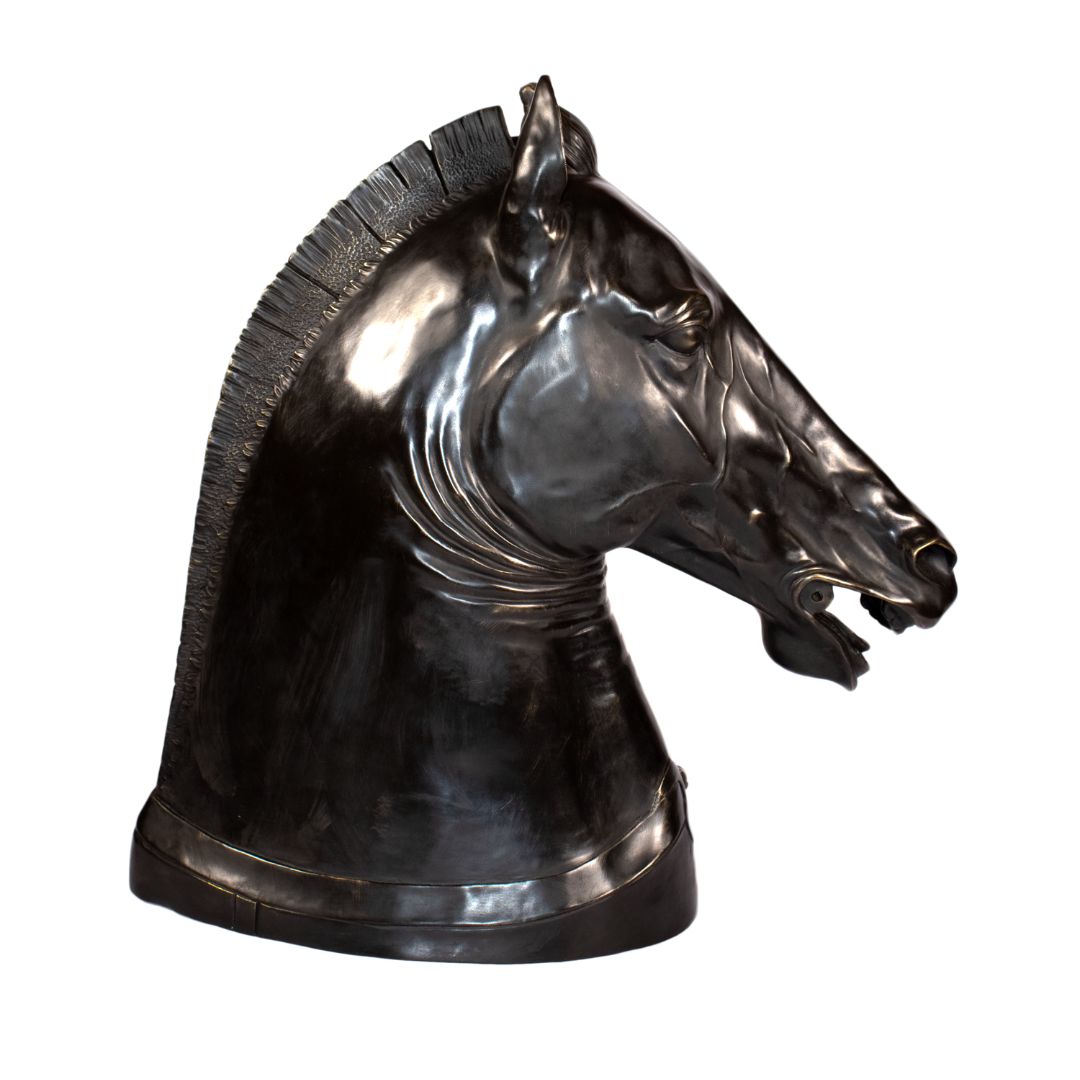
Classical Horse's Head — €2,725
KB0043 · Original: 438–432 BC, attributed to the workshop of Pheidias · Remade: 2026
After the horse of Selene, east pediment of the Parthenon, British Museum
Hand-cast bronze, dark brown patina (lost-wax method) · H 52 · L 45 · W 20.5 cm · 12 kg
This horse drew the chariot of the moon goddess Selene and, at the end of the night, sank exhausted below the horizon. Ears back, mouth open, veins taut over the bone: the sculptors of Pheidias fixed exhaustion in stone. The original is part of the Parthenon marbles in London, of which Reuvens bought plaster casts for the Rijksmuseum van Oudheden in 1820.
Hand-cast in bronze by KUZCO Art Maison, Amsterdam. 50% of your purchase price goes to this museum.
View the Classical Bronze Horse Head
Recumbent Lions after Canova — Pair — €850
KB0048 · Original: 1783–1792, Antonio Canova (1757–1822) · Remade: 2026
After the tomb of Pope Clement XIII, St Peter's Basilica, Rome
Hand-cast bronze, brown patina, on red-veined marble · H 17.5 · L 32 · W 12 cm · 12 kg (pair)
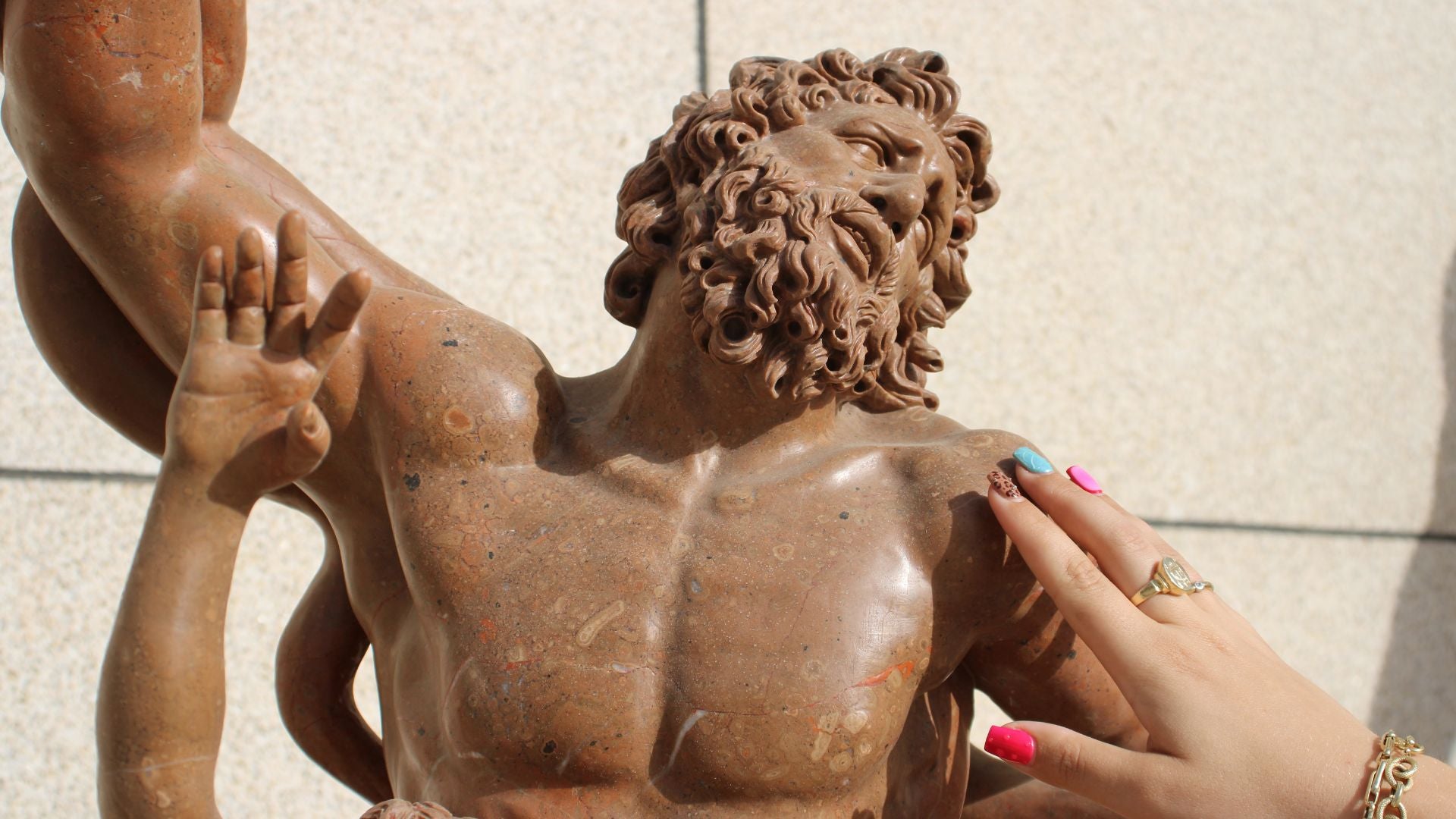
One lion keeps watch, the other sleeps. Canova meant it as a portrait in two halves: the sleeping lion stands for the pope's gentleness, the waking lion for his resolve. Nineteenth-century visitors went to St Peter's specially to see them, and bronze casts of the pair were among the best-selling Grand Tour souvenirs.
Hand-cast in bronze by KUZCO Art Maison, Amsterdam. 50% of your purchase price goes to this museum.
'Dancing Faun with Cymbals' — €445
KB0041 · Original: Roman version after a Hellenistic model, 2nd–1st century BC · Remade: 2026
After the Fauno danzante, Galleria degli Uffizi, Florence
Hand-cast bronze, green or brown patina (lost-wax method) · H 28 · L 13 · W 10.5 cm · 3 kg
Caught in the instant before the clash: one arm raised, the other lowered, the torso leaning back. The dancing faun from the Uffizi was one of the most copied statues of the Grand Tour: small enough for a travelling trunk, recognisable enough to open the conversation the moment you got home. A statuette as a mark of taste and culture, then and now.
Hand-cast in bronze by KUZCO Art Maison, Amsterdam. 50% of your purchase price goes to this museum.
View the Dancing Faun with Cymbals
Sphinx Candlesticks — Pair — €325
KB0046 · Original: Empire / Egyptian Revival, c. 1800–1830 · Remade: 2026
After the winged sphinx of the Empire style and the Egyptian Revival
Hand-cast bronze, brown patina, on a black-veined marble plinth · H 22 cm · 5 kg (pair)
A woman's head, a lion's body, wings: this is the Greek sphinx of the Oedipus myth, not the Egyptian one. After Napoleon's campaign in Egypt the motif was rediscovered across Europe and found its way onto clocks, candlesticks and furniture. Exactly as here: a riddle from antiquity holding a candle.
Hand-cast in bronze by KUZCO Art Maison, Amsterdam. 50% of your purchase price goes to this museum.
Porcelain Obelisks — Pair — €496
KP0033 · Original: Grand Tour / Empire type in malachite, 19th century · Remade: 2026
After the Grand Tour type in malachite with gilt mounts
Hand-painted porcelain and brass · H 14.5 cm · 2.5 kg (pair)
The malachite-green obelisk with gilt mounts is the drawing-room version of the Roman original. Those who could not afford granite bought the coloured stone, or, as here, the porcelain that imitates it. The obelisks are painted entirely by hand: today's craft applied to an antique form.
Hand-painted on Chinese porcelain by KUZCO Art Maison, Amsterdam. 50% of your purchase price goes to this museum.
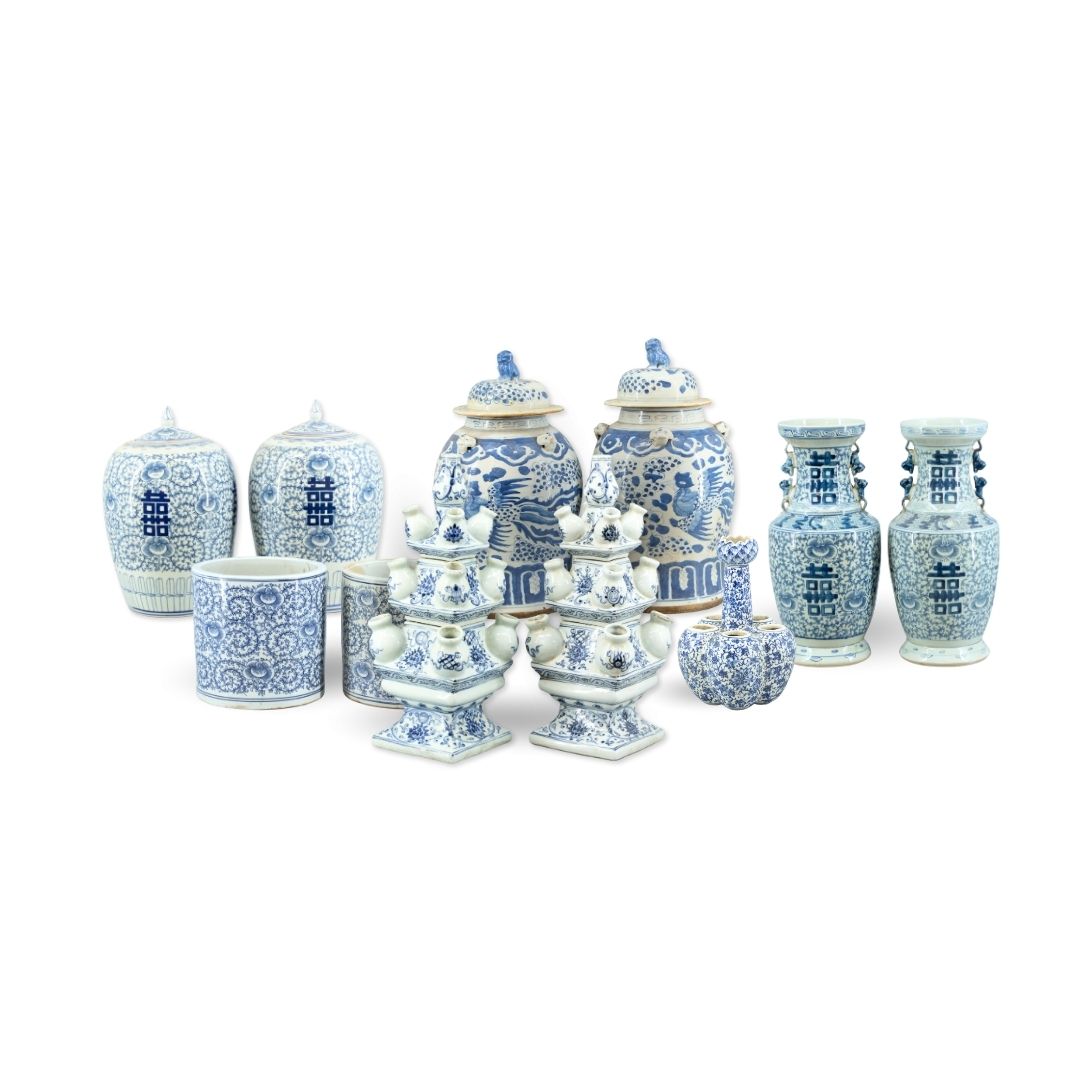
View the hand-painted Chinese porcelain
Material and craftsmanship: why no resin
Every piece in this collection is made in the material of the original. That is a choice with consequences: for the price, and for how long it lasts.
Marble and granite
Hand-carved from solid blocks. No cast stone powder, no composite. Weight is the first check: the Colossal Foot weighs 20 kg, the pair of granite obelisks 30 kg. You do not get that from a mould.
Bronze: the lost-wax method
The bronzes are cast using cire perdue, the lost-wax method, in use since around 3500 BC. The wax model literally disappears in the process, so no two casts are exactly identical. Want to know how that works, step by step? Read our full guide: How are bronze sculptures made?
Porcelain
Hand-painted on Chinese porcelain. More on the traditions behind it in our guide Which types of Chinese porcelain exist?
The problem with plastic and resin
Today, almost half of all decorative sculpture in the world is made of plastic or resin. That is material that ends up in a skip after a few years. What KUZCO makes lasts for generations, exactly as the pieces in the museum have.
About KUZCO Art Maison
"We believe the spaces we live in can inspire us as much as an exhibition."
KUZCO Art Maison was founded on a single conviction: that art-historical quality need not stay behind museum walls. We focus on quality, durability and accessibility, and make pieces that outlast human lifetimes. All sculptures are carved by hand or cast using the lost-wax method. Porcelain is painted by hand. The same craftsmanship and the same material as the originals.
Behind KUZCO is a family business that has been making sculpture for the international interiors world for more than twenty years. It is led by Lilly-Ann de Zeeuw, art historian and museologist, who believes that what you learn to appreciate in a museum, you should be able to keep seeing at home.
Frequently asked questions
Where exactly does the 50% go?
From every sale, 50% of your purchase price goes to the Rijksmuseum van Oudheden, earmarked for restoration, new acquisitions and research. The other 50% goes to the atelier and the artists who made the piece.
Can I take a piece straight from the museum?
Yes. Everything can be paid for on the spot and taken with you straight away. You can also pay now and contact KUZCO afterwards for home delivery; this carries an additional charge, set by KUZCO.
Do you ship abroad?
Yes, shipping is available within the Netherlands and abroad, worldwide.
Are these replicas of museum pieces?
Yes: they are reproductions in the Grand Tour tradition, purpose-made and dated reworkings of identifiable originals. Every piece states the year of the original and the year it was remade. No piece is presented as an original.
What is on the certificate?
The story of the original, your name, and the museum's thanks.
What are the pieces made of?
Hand-carved solid marble and granite, hand-cast bronze using the lost-wax method, and hand-painted Chinese porcelain. No resin, no composite.
Why are some originals not from the RMO?
The Grand Tour was a European journey, not a visit to a single collection. The pieces follow that route: from the Forum Romanum and the Uffizi to the Vatican Museums, the British Museum and the Rijksmuseum van Oudheden itself.
Take antiquity home
The Museum Grand Tour pieces are for sale in the Rijksmuseum van Oudheden and online. Every purchase supports the museum: 50% of your purchase price goes to the RMO.