
For anyone who works with, collects or simply loves Chinese porcelain, recognition is essential – not only to judge value, but to understand the story behind each object.
Many styles resemble one another. Fakes circulate widely. And without the right knowledge, celebrated works are often confused with earthenware or other kinds of porcelain.
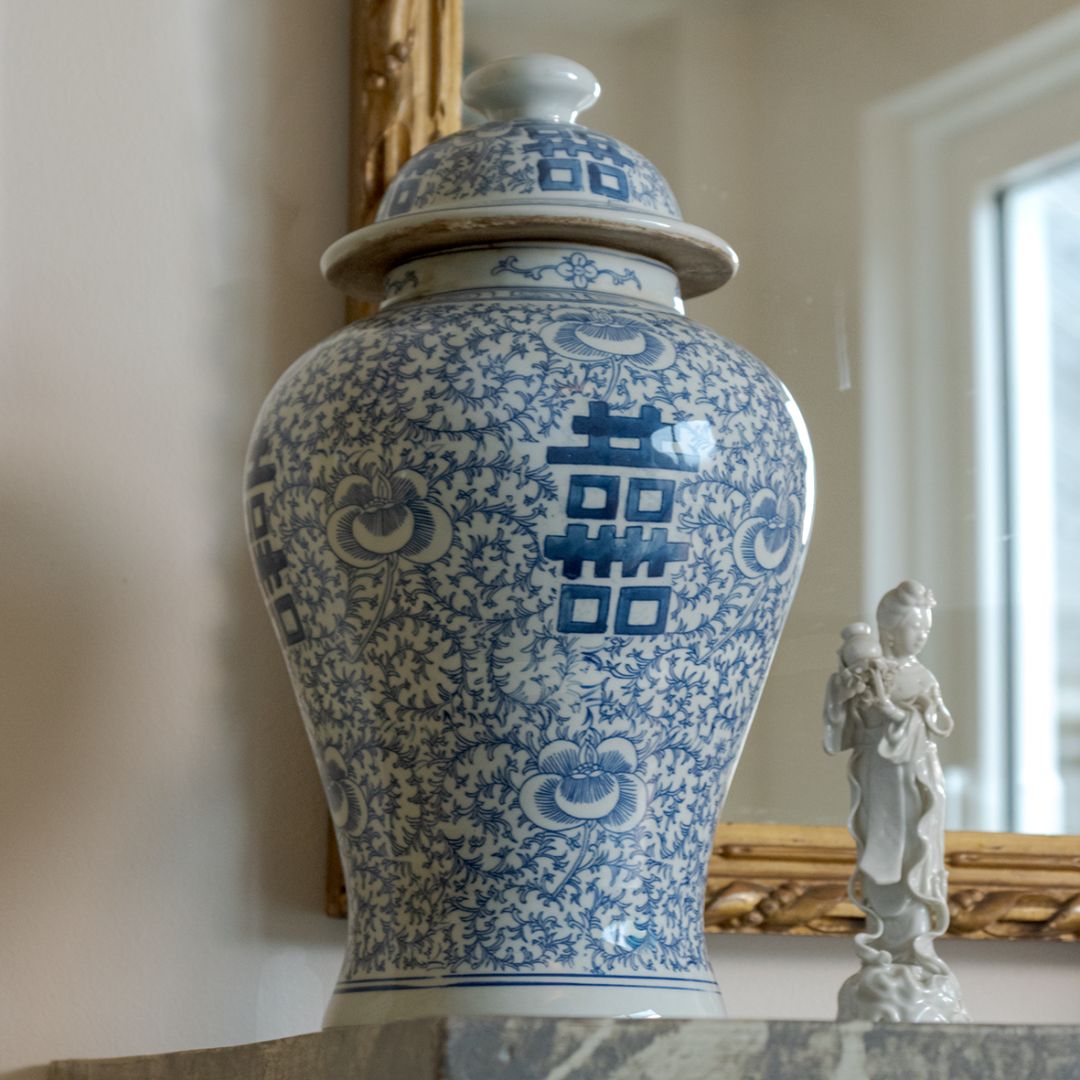
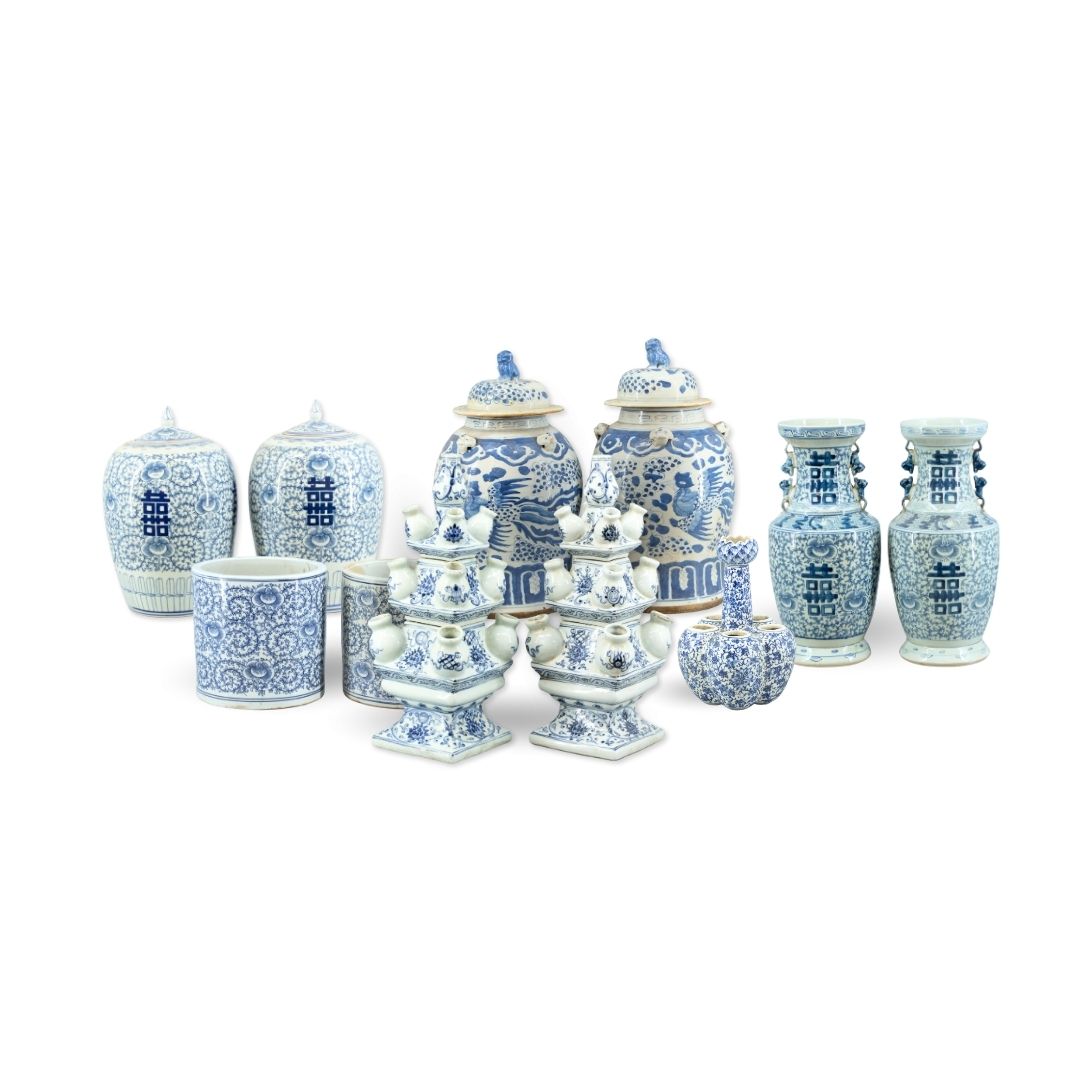
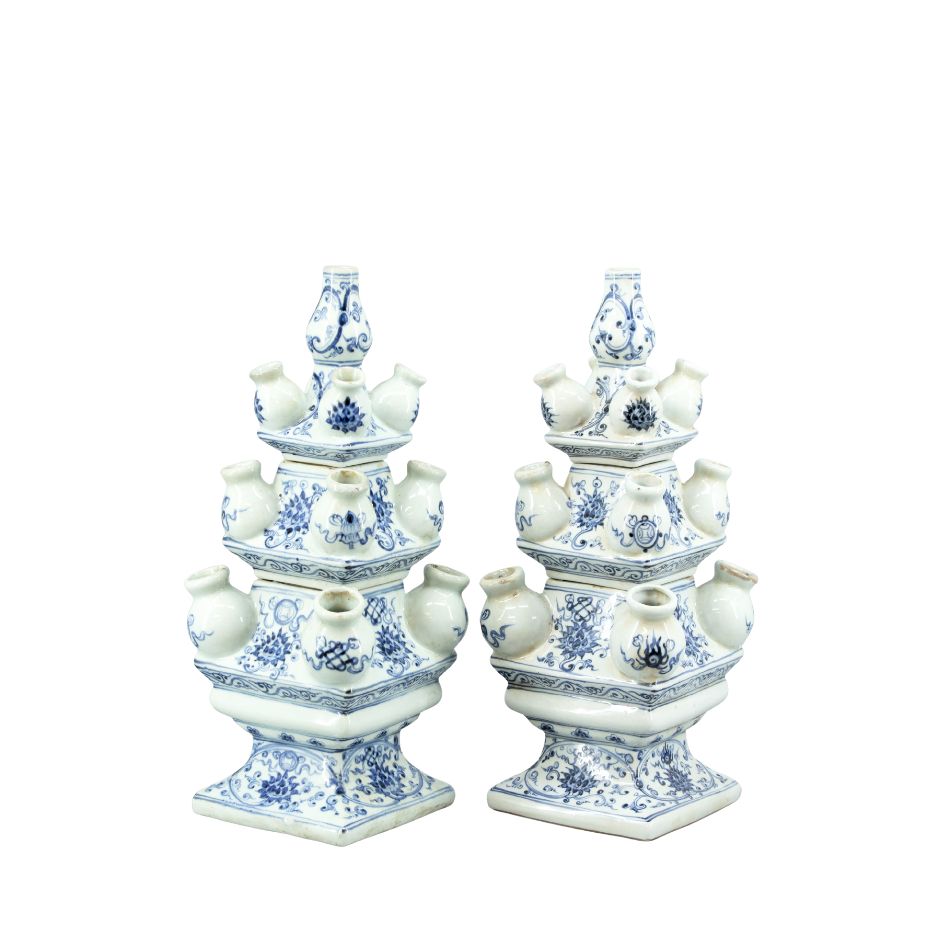
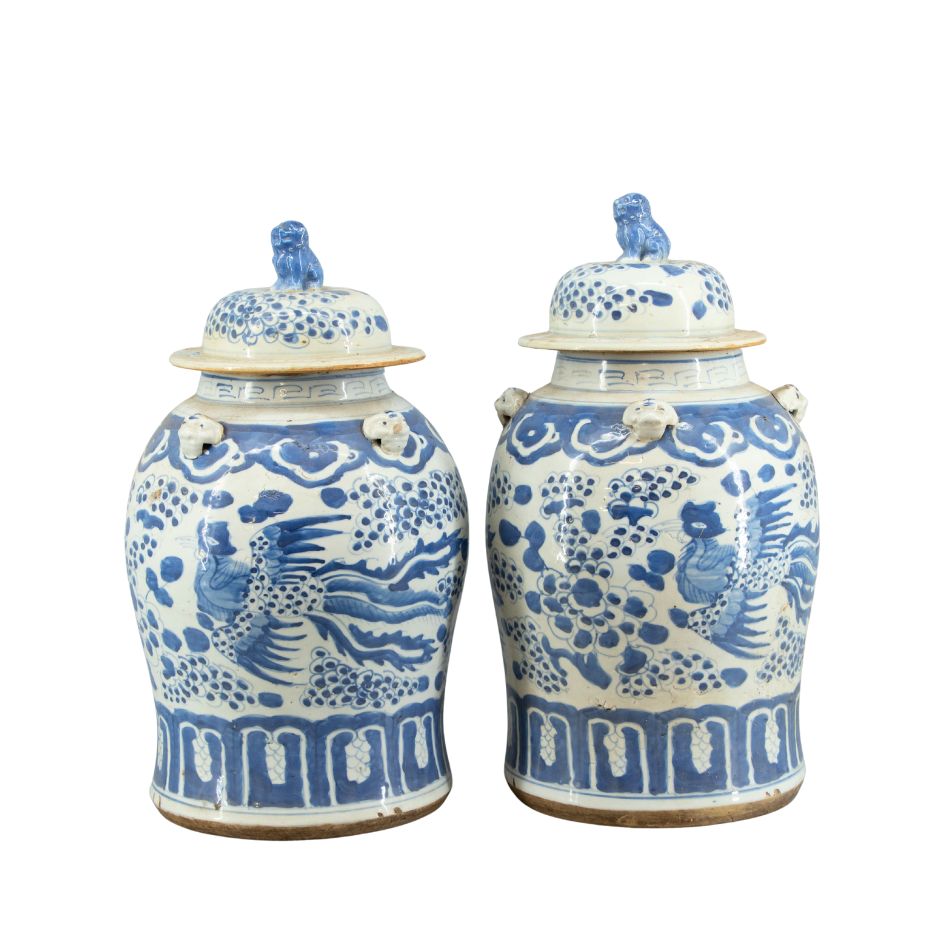
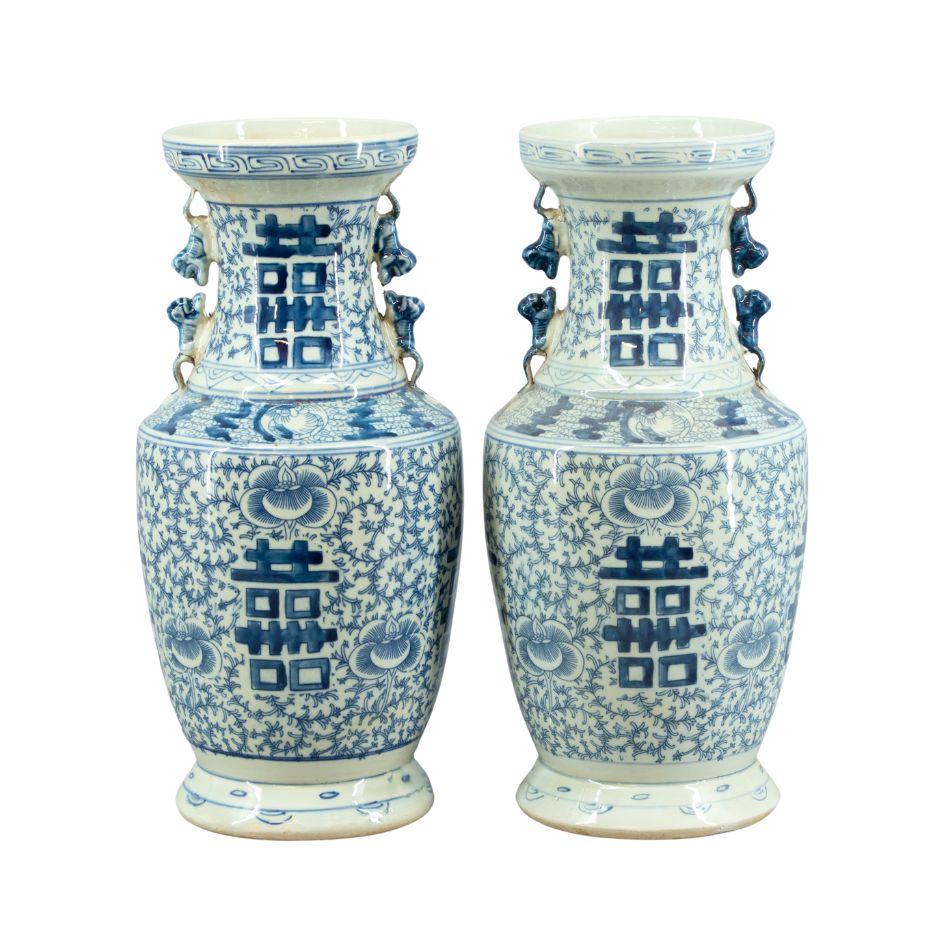
Alongside the styles, our collection includes many types of Chinese porcelain: lidded jars, ginger jars, Chinese baluster vases, jardinières and pagodas, all in antique style.
Key takeaways
- Chinese porcelain spans several celebrated styles, each tied to a specific dynasty or region – such as blue and white porcelain from the Yuan, Ming and Kangxi periods.
- These styles can be recognised by specific features such as colour, brushwork, form, type of glaze and decorative motifs.
- Each dynasty brought its own vision. The Ming dynasty, for instance, put porcelain on the world map through export and standardised production.
-
Some styles became famous worldwide because of their influence and export history, such as kraak porcelain through the 17th-century VOC trade.
Contents
- How to recognise kraak porcelain
- What sets Blanc de Chine apart?
- Famille verte vs famille rose: what are the differences?
- All about blue and white porcelain and the Kangxi style
- Celadon: jade in porcelain form
- The symbolic yellow glaze of the imperial court
- Jian ware and Jun ware: contrasting philosophies of glaze
- The doucai technique: colour in balance
- What is Kangxi revival porcelain?
- How to recognise Qing revival and Neo-Kangxi styles
- Export styles: Nanking Cargo & Chine de Commande
- What is chinoiserie porcelain?
What is kraak porcelain and why do collectors value it so highly?
Origins – Kraak porcelain is a term used in Western art history for a specific type of blue and white porcelain produced in the late Ming dynasty (particularly under the Wanli Emperor, c. 1573–1620).
The name 'kraak' probably derives from the Portuguese ships (carracks) on which these objects reached Europe along VOC trade routes.
Characteristics – The porcelain is distinguished by a central medallion surrounded by panels showing symbolic decoration such as lotus flowers, peonies or landscapes. The decoration is applied relatively freely, with expressive brushwork and at times asymmetrical compositions – features now regarded as part of its charm and character.
What makes kraak porcelain special is its early role as an export ware: it was one of the first porcelain styles to circulate in Europe on a large scale, and so became the blueprint for European imitations, including Delftware.

What makes Blanc de Chine so distinctive in form and appearance?
Origins – Blanc de Chine, produced in Dehua (Fujian province) since the Ming dynasty, is an exceptional category of white porcelain.
Characteristics – The porcelain is unglazed or covered with a thin, ivory-toned transparent glaze that underlines the technical command of the Dehua kilns.
It is best known for its Buddhist and Taoist figures, notably the serene images of Guanyin, the bodhisattva of compassion. The figures are often hollow-moulded and finished by hand, creating a subtle play of light and shadow.
Blanc de Chine stands for spiritual purity, stillness and craftsmanship. In the 17th century it was also exported to Europe, where – under the influence of the Jesuit missions – it was reinterpreted in religious terms as the Madonna and Child.
What is the difference between famille verte and famille rose porcelain?
Origins – The terms famille verte and famille rose are French classifications introduced by European collectors to distinguish the different overglaze enamel palettes on Qing porcelain.
Characteristics
- Famille verte ('green family') dominates the Kangxi period (1662–1722) and is marked by the extensive use of iron red, yellow, black and above all a transparent green enamel. The motifs are narrative – ladies in gardens, hunting scenes, literary and symbolic subjects – with fine brushwork and an asymmetrical division of the surface.
- Famille rose ('pink family') flourished under the Yongzheng and Qianlong emperors (1723–1795). The style introduced new lead-based enamels, including a pastel pink based on gold chloride, which allowed finer gradations of colour and more detailed facial expressions.
Famille rose marks a shift towards a more intimate, refined court aesthetic and sits closely with the rococo taste of European courts, particularly in France and Germany.

What are the characteristics of blue and white Chinese porcelain?
Origins – Blue and white porcelain (qinghua) is perhaps the best-known and most universally recognisable form of Chinese porcelain. It originated in the Yuan dynasty (1271–1368), but the genre reached its artistic peak under the Ming and early Qing emperors.
Characteristics – The secret of this porcelain lies in the combination of bright white kaolin and deep blue cobalt oxide – originally imported from Persia.
The motifs, ranging from landscapes to dragons, birds and poetic calligraphy, were painted by hand before glazing and then fired at high temperature.
Blue and white porcelain was not only an artistic medium but also a geopolitical trade commodity. In the 17th century it found its way to Istanbul, Amsterdam and even Mexico City, where it was absorbed into local traditions.
What is celadon porcelain and how does its jade-green colour arise?
Origins – Celadon (qingci) refers to the type of glaze rather than to the body, and has its roots in the Eastern Han dynasty. The celadon tradition was cultivated in the Tang period and perfected in the Song dynasty, above all at the famous Longquan kilns.
Characteristics – The characteristic jade-green colour comes from an iron-bearing glaze fired in an oxygen-poor (reducing) kiln atmosphere. Its visual likeness to jade – the most prized material in Chinese culture – explains the prestige of the style.
Celadon porcelain often shows restrained forms, with motifs such as lotus flowers or stylised wave patterns, sometimes hidden in relief beneath the glaze. It expresses the visual stillness of Song aesthetics: harmony, balance and contemplation.

What is yellow-glazed porcelain and why was it reserved for the emperor?
Origins – During the Ming and Qing dynasties, yellow glaze was regarded as the preserve of the imperial court. Yellow, the colour of earth in the traditional Chinese cosmological model (wu xing), symbolised the centre, stability and imperial authority.
In the Ming period (especially under the Hongzhi Emperor, 1488–1505), monochrome yellow glaze on white porcelain was reserved exclusively for objects intended for ritual and ceremonial use within the Forbidden City.
These works were usually produced at Jingdezhen, resulting in delicate dishes, bowls and small offering dishes. It took exceptional skill to apply the lead-bearing glaze evenly and keep it from discolouring during high-temperature firing. Combined with the sober design, this gave the porcelain a restrained, almost sacred presence.
What is Jian ware and how does it differ from Jun ware?
Jian ware is a type of stoneware from Fujian, celebrated during the Song dynasty (960–1279) above all for the deep black glazes used in tea ceremonies at Zen Buddhist monasteries. The bowls often show an iron-saturated glaze that separates naturally into 'hare's fur' or 'oil spot' patterns – abstract, cosmic textures that heighten the meditative character of the object.
Jun ware, produced in Henan, is a sharp contrast: this stoneware is heavy, with thick, milky blue to purple glazes. Applying copper oxide over a base glaze produced striking splashes of colour during firing. No two pieces are alike – each is a chance creation of fire and chemistry, which is why Jun ware is prized by collectors with an eye for form and colour.
What is doucai porcelain and how can it be recognised?
Doucai (斗彩), literally 'contrasting colours', is a technique perfected under the Chenghua Emperor (Ming dynasty, 15th century). The outlines of the design were painted in underglaze blue; the object was then glazed and fired, and afterwards detailed with overglaze colours such as iron red, green and yellow. The whole piece was then fired again at a lower temperature.
The result is an elegant, airy composition in which the colours stay clear and the outlines contrast finely with the glaze. The most famous doucai works are the 'chicken cups' – delicate cups with cockerels, hens and chicks – which stand for harmony, fertility and family happiness.

What is Kangxi revival porcelain and why is it so popular?
In the 19th century, during the late Qing period, the porcelain styles of the Kangxi era were strongly revalued. The so-called Kangxi revival style reflects a nostalgic and commercial revival of that earlier aesthetic, largely for the export market.
What exactly does the term Kangxi revival style mean?
The Kangxi revival style covers porcelain made after the 18th century – often at Jingdezhen – that deliberately refers to the formal, decorative and technical features of the Kangxi period (1662–1722).
These reinterpretations used the same cobalt pigments, five-colour techniques (wucai) and floral and landscape motifs, but were sometimes adapted to the taste of European collectors.
Revival pieces often have a slightly heavier body and a more systematic repetition of patterns, which sets them apart from genuine Kangxi-period objects.

What is the difference between Kangxi revival and Yongzheng revival?
The Yongzheng revival style is more restrained and refined than its Kangxi counterpart. It favours soft transitions, pastel colours and finer brushwork – echoes of the imperial Yongzheng aesthetic (1723–1735), known for its pursuit of elegance and precision.
Revival pieces in this style are often smaller and focus on floral still lifes, elegant ladies or mythological birds such as the phoenix. They were usually made both for the domestic elite and for foreign collectors with a taste for refinement.
What is Qing revival porcelain?
Qing revival porcelain refers to a broader 19th-century movement of reproduction porcelain in which styles from the whole Qing period were brought back to life. These pieces often combine elements from different sub-periods – Kangxi, Yongzheng, Qianlong – and reflect the scholarly and commercial revival of traditional aesthetics at a time of cultural uncertainty and Western influence.
These objects often deliberately carry old imperial reign marks, which led to confusion (and speculation) among European collectors and museums in the 19th and 20th centuries.
What is Kangxi blue and white porcelain?
Kangxi blue and white porcelain represents a particular level of refinement within the older blue and white genre. The cobalt blue is lively but not saturated; brushstrokes are subtle, with clear variation in thickness and depth. The compositions are dynamic yet harmonious, with close attention to negative space.
Typical motifs include landscapes with misty mountains, bamboo groves, cranes and scenes from popular novels such as Dream of the Red Chamber. These porcelain objects combine technical command with a refined, often poetic imagery.
What are Kangxi five colours (wucai) in Chinese porcelain?
Wucai (五彩), or 'five colours', is a decorative style that combines underglaze blue with overglaze enamels in red, green, yellow and black. In the Kangxi period the technique was refined further, with lively scenes on large vases, dishes and jars.
The decoration is narrative and animated: imperial dragons, Taoist immortals or children playing in gardens. The palette was so strong and appealing that it was widely followed, both in later Chinese production and in European imitation.

What is 19th-century Kangxi-style export porcelain?
Influenced by European neoclassical taste in the 19th century, Kangxi-style porcelain was produced on a large scale specifically for export. These pieces are often larger, heavier and more symmetrical in design than their 17th-century models. The decoration is colourful but disciplined, sometimes on European forms (such as candlesticks or armorial dinner services).
They were popular with collectors in England, France and Germany, where 'Chinese blue' became a fascination. These pieces played a central role in shaping the European image of 'chinoiserie'.
What is the Nanking Cargo style?
The Nanking Cargo style refers to the cargo of the VOC ship Geldermalsen, which sank in 1752 and was discovered in 1985. On board was a vast quantity of blue and white porcelain – tea bowls, saucers, ginger jars – made specifically for the European market.
The decoration is typically 18th-century Qing: stylised flowers and symbols of happiness and prosperity, sometimes combined with landscape elements. The discovery of the wreck revived interest in this kind of export porcelain and led to thousands of reproductions – often in the so-called 'Nanking Cargo style'.
What does Chine de Commande mean in the world of porcelain?
Chine de commande ('porcelain to order') is the term for porcelain made to commission for European clients between the 17th and 19th centuries. These pieces often carry family coats of arms, initials, Christian motifs or landscapes that do not belong to the Chinese pictorial tradition.
The objects were made at Jingdezhen, but based on drawings or engravings supplied by European merchants. They are tangible evidence of cross-cultural exchange between East and West, and today form a specialist field within private and museum collections.
What is Neo-Kangxi porcelain?
Neo-Kangxi is a present-day term for modern replicas or reinterpretations of the classic Kangxi style, mostly made since the late 20th century. These pieces combine historical decoration with modern techniques and materials, and are often intended for museum reconstructions, interiors or educational purposes.
While some replicas are meant as a tribute to lost techniques, commercial versions also circulate on the antiques market – of varying quality and reliability.
What is chinoiserie porcelain and how did it arise?
Chinoiserie is a European aesthetic that imitates and romanticises Chinese art and design, especially during the Baroque and Rococo (18th century). Chinoiserie porcelain was produced both in Europe and in China itself. In the latter case it was known as 'Chine de commande', with Chinese craftsmen depicting European fantasies of 'the East'.
The motifs are exotic and playful: mandarins in pavilions, dragons, pagodas and flowers in asymmetrical compositions. Chinoiserie reflects Europe's longing for the unknown more than China itself.